Can You Walk The National Mall In One Day?
Yes, you can walk the National Mall in one day, but the distances and closures add up. Here is how walkers and riders each cover the monuments, with tour timings and seasonal advice.
Yes, you can walk the National Mall in one day. National Mall and Memorial Parks is open 24 hours a day, the major memorials line up in one continuous sequence, and determined walkers cover the Capitol end to the Lincoln end plus the Tidal Basin memorials in a single visit. The catch is cumulative distance and fatigue, which is exactly the trade-off guided bike rides solve.
The National Park Service keeps the park open around the clock, per the park's official visit page, so nothing about access forces a schedule on you. The practical limits are your legs, the weather, and a couple of construction closures in force right now. The Lincoln Memorial Reflecting Pool, its adjacent walkways and the grass medians are closed until Friday 20 November 2026 at 11:59 p.m., and the west side of the Washington Monument Grounds is closed through 23 January 2027 for turf restoration. Neither closure blocks the Mall itself, but both reshape a walking route, and both are reasons to check the NPS notices before you set out.
Bicycles are welcome in National Mall and Memorial Parks, with bicycle parking near each major memorial, and riding inside the memorials themselves is not permitted; you walk the bike through the World War II and Franklin Delano Roosevelt Memorials, or lock it up before entering, exactly as the park's bicycling information page states. That single rule explains the whole ride-versus-walk decision: a bike covers the long stretches between memorials quickly, and you still walk each memorial on foot once you arrive. Walkers do the same distances at walking pace, all day.
If one long day on foot sounds like more than you want, the guided options compress the same sight list dramatically. A 3-hour guided monuments ride such as the Washington DC: Monuments and Memorials Bike Tour covers the major memorials with a guide narrating between stops, and you can check availability if that pace appeals.
For readers who want the fuller picture of pairing a ride with an evening stroll, our guide to a night ride past the monuments after dark covers what changes after sunset.
What Does A Full Day Of Walking Actually Look Like?
A realistic walking day splits into three blocks: the Capitol and museum row, the Washington Monument stretch, and the western memorial cluster plus the Tidal Basin loop. Walkers who start early, take a lunch break, and accept that some interiors get skipped finish the circuit by early evening. Anyone starting after midday usually has to cut the Tidal Basin or the museum interiors.
The morning belongs to the east end. The United States Capitol grounds and the museum row along the Mall are the natural starting sequence, and the museums are where walking days quietly die: each one is an easy two hours if you let it be. A one-day walking plan treats museums as a single choice, not a list. Pick one or walk past all of them, because the line of Smithsonian buildings alone can swallow a full day before you reach a single memorial.
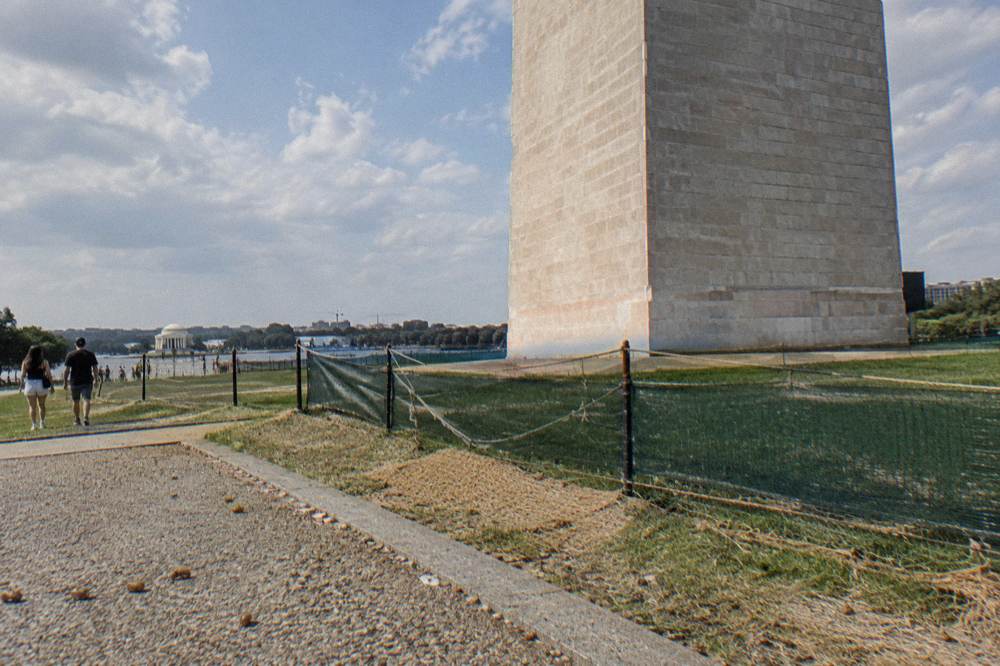
Midday covers the Monument core. The Washington Monument stands 555 feet 5 1/8 inches tall and anchors the middle of the park, but the grounds are partly closed right now, with the west side shut through 23 January 2027 after the earlier north and south turf closure ended in September 2026. The monument itself, if open for tickets, is a time commitment; a one-day walking plan usually photographs it and moves on. The surrounding grass panels, normally the Mall's picnic and rest zone, are partly fenced, which also removes the easiest midday rest spots, another small tax on a walking plan that a rider never feels.
The afternoon and evening go west and south. The World War II Memorial sits at the head of the Reflecting Pool, then the Lincoln Memorial, then the Korean War and Vietnam Veterans Memorials flanking the pool, then the Martin Luther King Jr., Franklin Delano Roosevelt and Jefferson Memorials around the Tidal Basin. That final cluster is where tired legs meet the longest uninterrupted walking stretch of the day. Sunset matters here: at the end of October, the sun goes down at 6:08 p.m. in Washington, and the lit memorials after dark are the reward for anyone still standing.
The order matters more than walkers expect. Going east to west puts the Tidal Basin loop, the most exposed and least shaded stretch, at the hottest and most crowded hours. Reversing the day, starting at the Lincoln Memorial early and finishing at the Capitol, puts the memorials in morning light and cooler air, and leaves the shaded museum row for the afternoon heat. Either direction works; what fails is improvising the order on the fly with tired feet and a setting sun.
Which Memorials Fit Into One Walking Day?
The realistic one-day list is the World War II Memorial, the Lincoln Memorial, the Vietnam Veterans and Korean War Memorials, and the Martin Luther King Jr., Franklin Delano Roosevelt and Jefferson Memorials around the Tidal Basin, plus the Washington Monument grounds and the Capitol exterior. Everything on that list sits in one continuous walkable sequence. Museum interiors and monument interiors are the two things a one-day plan must ration.
That list is not cherry-picked; it is the sequence the guided rides use too. The 3-hour monuments rides cover the same memorial cluster, just faster between stops. Here is how the one-day sight list breaks down for a walker versus a rider:
| Stop on the classic circuit | Walker's reality | Rider's reality |
|---|---|---|
| United States Capitol (exterior) | Starting point, fresh legs | Starting point or first stop |
| Washington Monument grounds | Photo stop; west side closed through 23 January 2027 | Brief stop, same closure applies |
| World War II Memorial | Walk the bike rule applies to riders; both arrive on foot | Lock or walk the bike, then join |
| Lincoln Memorial | Big climb of steps; Reflecting Pool walkways closed until 20 November 2026 | Same memorial, legs still fresh |
| Vietnam Veterans Memorial | Short detour north of the pool | Quick stop on the same circuit |
| Korean War Veterans Memorial | Short detour south of the pool | Quick stop on the same circuit |
| Martin Luther King Jr. Memorial | Tidal Basin side, longer exposed stretch | Minutes by bike |
| Franklin Delano Roosevelt Memorial | Walk-through memorial, no riding inside | Walk the bike through, per park rules |
| Jefferson Memorial | Farthest point of the Tidal Basin loop | Farthest point, arrived quickly |
Two things jump out of that table. First, every memorial is experienced on foot either way; the ride saves the distance between stops, not the stops themselves. Second, the three Tidal Basin memorials sit at the far end of the day for a walker, which is why so many one-day plans quietly drop them. The rides on this site exist largely for this reason: the Jefferson Memorial is the monument walkers most often report missing, and it is a few minutes of pedaling for a rider.
How Long Do The Guided Rides Take Compared To Walking?
The guided rides on the National Mall take 2 to 3 hours for the standard monument circuits, against a full walking day for the same ground. A 3-hour monuments ride covers the major memorials; a 2-hour Capitol Hill ride covers the east end; a 3-hour e-bike ride adds the Tidal Basin circuit at an easier effort level. Walking covers the identical list at several times the time cost.
Here is how the timing options stack up, using the durations each listing states:
| Option | Stated duration | Bike type | Format | Best for |
|---|---|---|---|---|
| Monuments and Memorials Bike Tour | 3 hours | Classic | Shared guided ride | The full memorial list in one circuit |
| Monuments Ride with E-Bike Upgrade | 3 hours | E-bike option | Shared guided ride | Same circuit with pedal assist |
| Best of Capitol Hill Bike Tour | 2 hours | Classic | Shared guided ride | The Capitol end only |
| National Mall & Tidal Basin E-Bike Tour | 3 hours | E-bike | Shared guided ride | The Mall plus the Tidal Basin loop |
| Easy Capitol Hill Highlights ride | 2 hours | Classic | Shared guided ride | A shorter east-end orientation |
| Walking the same ground | A full day | None | Self-guided | Maximum flexibility, museum interiors |
The pattern is simple: guided rides take the distances that eat a walking day and compress them into a guided circuit. The listings describe the meeting point and inclusions for each ride, and those details vary between operators, so check the booking page for anything that matters to your decision, such as where you meet and whether a helmet is included. DC law requires a helmet for anyone under 16 riding on a public roadway or path, a point worth knowing for families comparing options.
The math favors riders hardest on the Tidal Basin. A walker who has already gone Capitol to Lincoln, both Vietnam and Korean War Memorials included, then adds the King, Roosevelt and Jefferson loop, has stacked the day's longest stretches back to back. A rider on the 3-hour e-bike version of the circuit arrives at Jefferson with legs that still work, and the listing's pedal-assist framing means the effort level stays flat across the whole loop.
The 2-hour Capitol Hill ride suits visitors who only have a morning or who want the east end covered before spending the afternoon elsewhere. A short Capitol Hill guided ride pairs naturally with a museum afternoon on foot.
If your question is bigger than the Mall itself, our piece on the best way to see all the monuments in DC walks through the same trade-off for the whole city.
When Is The Best Time Of Day To Cover The Mall?
Early morning and the hours around sunset are the two best windows for covering the Mall, and the park being open 24 hours makes both legal and easy. Mornings give empty paths and cool air; sunset gives the lit memorials and the golden light photographers want. Midday works but costs more in heat and crowds, especially from June through August.
The climate record for Washington supports the early start. NOAA's 1991 to 2020 normals for Reagan National Airport put the average July high at 89.6°F with an average low of 72.4°F, and June averages are nearly as warm. April and May average highs of 68.0°F and 76.5°F, which is why spring is the most forgiving walking season. October averages a 69.4°F high with under five rainy days in the month, making autumn the second-best window for a long day on foot. Winter walking is entirely possible, with January normals of a 44.8°F high and 30.1°F low, provided you dress for it; our cold and wet weather riding guide covers the same logic for riders.
The National Park Service keeps the park open 24 hours, so an evening finish is not a scramble against closing time the way it is at many urban parks. The memorials are lit at night, and Capital Bikeshare itself recommends evening rides on the Mall's car-free paths for exactly this reason. A walk that starts at the Lincoln Memorial at dusk and finishes at the Capitol after dark is a genuinely good plan, not a consolation prize. Sunrise sits at 7:34 a.m. at the end of October, so even the earliest starts have full daylight to work with.
The wildcard is events. Through 2026 the Mall has seen repeated temporary closures for events and work, from Independence Day security perimeters in July to October's nighttime closures of Maine Avenue SW and Ohio Drive for Long Bridge Project work. A one-day plan built around a single afternoon can be wrecked by one of these. Checking the NPS notices the morning you go is the cheap insurance, and it costs nothing to fold into a coffee stop.
What About Closures And Construction?
Two closures currently reshape a Mall visit: the Lincoln Memorial Reflecting Pool and its adjacent walkways are closed until 20 November 2026, and the Washington Monument Grounds west side is closed through 23 January 2027. Both affect walking routes more than riding routes, because riders adjust in minutes while walkers detour on tired legs.
The Reflecting Pool closure is the bigger visual loss for walkers; the pool and its bordering walkways are the classic approach to the Lincoln Memorial. The notice runs through Friday 20 November 2026 at 11:59 p.m., and it has been extended more than once during the year, so verify it on the day. The memorial itself remains reachable by other approaches, and the Vietnam and Korean War Memorials flanking the pool are unaffected.
Construction is also why the e-bike option earns its keep. The 3-hour National Mall & Tidal Basin e-bike ride keeps the full circuit comfortable even with detours, because pedal assist absorbs the extra distance a closure adds. For a deeper comparison of the two bike types, see e-bike or regular bike for seeing DC.
Detours hit walkers hardest at exactly the wrong moment, late in the day, when the Tidal Basin loop sits between you and dinner. A rider absorbs the same detour in a few minutes of turning pedals. Cherry blossom season deserves a special mention here: the Tidal Basin area was closed through the 2026 festival for seawall landscape work, and 2026's peak bloom arrived on 26 March. The 2027 festival runs 20 March to 11 April 2027, and no peak bloom forecast for 2027 has been published yet, so anyone planning a spring walk should watch the NPS bloom page rather than a date someone guessed. Our cherry blossom peak bloom timing guide covers that season in detail.
Bike Share Or A Guided Ride?
A Capital Bikeshare day pass at $10 per 24 hours suits confident riders who know where they are going; a guided ride suits visitors who want the narrated context and the logistics handled. The day pass includes classic rides free for the first 45 minutes each, then $0.05 per minute, with e-bikes at $0.15 per minute. Guided ride prices are on each booking page.
The economics only tell half the story. Here is the verified public pricing side by side, as published on the official system pricing page:
| Capital Bikeshare option | Price | What it includes |
|---|---|---|
| Single ride | $1 unlock plus $0.15 per minute classic, $0.35 per minute e-bike | Pay as you go, no commitment |
| Day pass | $10 per 24 hours | Classic rides free for the first 45 minutes each, then $0.05 per minute; e-bikes $0.15 per minute |
| 30-day membership | $25 per month | Same 45-minute classic terms, e-bikes at $0.15 per minute |
| Annual membership | $120 per year | Same terms, free unlocks |
The 45-minute classic-ride window actually fits the Mall well: with about 8,000 bikes across more than 800 stations in eight jurisdictions, and a station back on the Mall itself after its late October 2026 reinstatement, a visitor can hop between memorial clusters, dock within the free window, and repeat all day on one $10 pass. The trade-off is that you supply the route, the timing and the history. A guided monuments ride supplies a guide, a narrated route between the same memorials and a set meeting point, in a stated 3-hour block.
Families should weigh one more factor: DC law requires a helmet for anyone under 16 riding on a public roadway or path, and guided operators typically state their helmet policy and any rider-age terms on the booking page. Check those before booking rather than at the meeting point. The private family-friendly rides, which run 3 hours with a route built around younger riders, are the natural fallback if the shared circuit's pace sounds wrong for your group; details and prices are on each booking page.
What Should You Eat, Drink And Carry For A Mall Day?
Carry more water than feels reasonable, plan food around the museum blocks or a food truck line rather than the memorial end, and wear shoes that have already survived a long day. The memorial cluster west of the Washington Monument has little shade and fewer services than the museum row, so the practical failures of a Mall day are dehydration and blisters, not distance.
The east end solves itself: the museum row and the streets just south of the Mall hold most of the realistic lunch options, and food trucks cluster along the Mall's edges on busy days. The west end is thinner. By the time a walker reaches the Tidal Basin loop, the closest reliable food and water are back toward the museums or across the river in Arlington, which is a detour nobody wants at hour eight.
Weather turns the same advice up a notch. July averages 4.33 inches of rain across 6.7 rainy days, and summer thunderstorms in Washington arrive fast and hard; a walker mid-Tidal Basin loop has limited cover, while a rider is minutes from a dock or a museum lobby. The NOAA normals also show May and June as the wetter spring months, at 3.94 and 4.2 inches respectively, so a light shell layer earns its space in a daypack for most of the year. Our what to wear for a DC bike ride guide translates the same normals into clothing choices.
Rest, like food, is easier east. The grass panels around the Washington Monument were the classic rest zone, but the west-side closure through 23 January 2027 removes part of that, and museum benches and steps carry the load instead. Plan a real sit-down break at midday, not a standing pause, because the afternoon half of the circuit is the longer half.
Common Questions About Walking The National Mall
Can You Walk The National Mall In One Day?
Yes. National Mall and Memorial Parks is open 24 hours, the major memorials sit in one continuous sequence, and most walkers finish the circuit in a long day by starting early and choosing at most one museum interior. A guided bike ride covers the same memorial list in a stated 3 hours.
How Far In Advance Should I Check For Closures?
Check the National Park Service notices the same week you visit. The Reflecting Pool closure running through 20 November 2026 has been extended more than once, and event-related closures around the Mall appear with short notice throughout the year.
Can I Ride A Bike Between The Memorials?
Yes, bicycles are welcome in National Mall and Memorial Parks and parking is provided near each major memorial. Riding inside the memorials is not permitted; walk the bike through the World War II and Franklin Delano Roosevelt Memorials or lock it up before entering.
Is The National Mall Open At Night?
Yes, the park is open 24 hours a day. The memorials are lit after dark, and the sun sets around 6:08 p.m. in Washington at the end of October, so an evening finish is both possible and rewarding.
Which Season Is Easiest For A Full Walking Day?
Spring and autumn. April averages a high of 68°F and October 69.4°F in the 1991 to 2020 NOAA normals, against July's average high of 89.6°F. Cherry blossom season is spectacular but crowded; the 2027 festival runs 20 March to 11 April 2027.
Is A Guided Ride Better Than Walking?
Neither is better outright. Walking gives maximum flexibility and museum interiors; a guided ride compresses the memorial circuit into a stated 2 to 3 hours with a guide narrating the stops. Many visitors walk the east end and ride the memorial cluster.