Can You Use Capital Bikeshare Without The App?
Can you ride Capital Bikeshare in Washington DC without a smartphone app? The verified pricing tiers, what to confirm before you go, and when a guided bike tour is the easier answer.
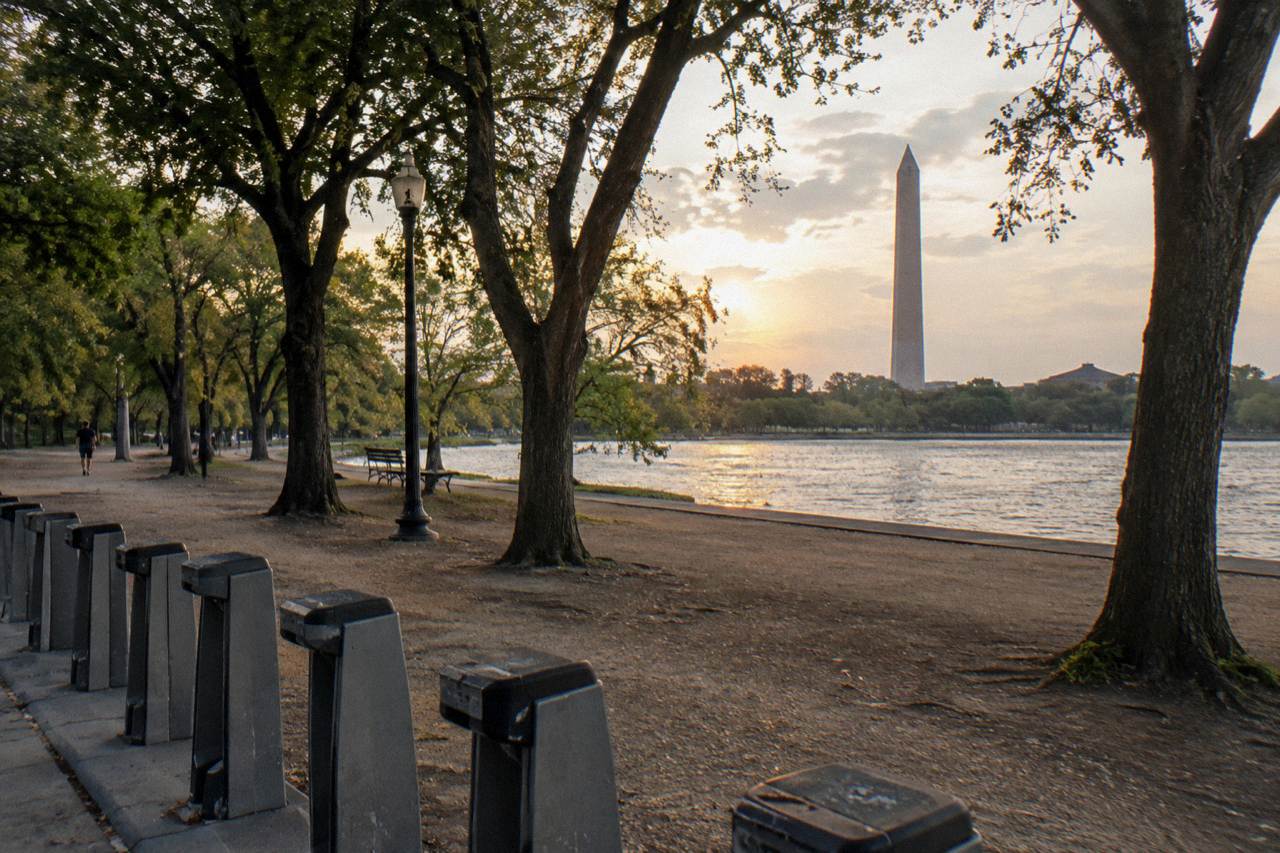
Washington DC runs one of the largest bike-share systems in the country, about 8,000 bikes across more than 800 stations in 8 jurisdictions, and nearly every visitor notices the red frames locked into docks along the National Mall within minutes of arriving. The question is practical, not lazy: if your phone battery dies, if you are traveling with a teenager whose phone is in airplane mode, or if you simply dislike installing an app for a two-day trip, can you still ride?
The pricing side is simple: Capital Bikeshare publishes its rates openly. A single ride costs a $1 unlock plus per-minute charges, and a day pass runs $10 for 24 hours. The unlock methods are murkier. Whether any of them work without the app is a question to put directly to Capital Bikeshare before you count on it. If you would rather skip the app question entirely, our guide to guided bike ride pricing in DC walks through what a tour charges per person and per group, and how that stacks up against a day pass.
The short answer: yes, in most cases you can. The details below separate what you can count on from what you should confirm yourself before riding, and they end with the alternative that makes the whole question disappear: a guided bike tour, where the operator brings the bike, the helmet and the route, and your phone stays in your pocket taking photos.
Here is the split, stated plainly. Pricing tiers, system size and riding rules on parkland are all public, so planning around them is easy. The unlock process is murkier: Capital Bikeshare does not clearly publish a no-app unlock method, such as a kiosk, a tap card or a phone call. The safest move is to ask Capital Bikeshare directly about current unlock options before your trip, rather than assuming any one of them exists.
Why does this matter so much? Because the failure mode is ugly. A traveler who assumes there is a kiosk at every station, arrives at a dock on a hot afternoon, and finds no screen and no card reader has no bike and no backup plan. The system's pricing pages describe rides, passes and memberships in detail, but the mechanics of unlocking a specific dock are exactly the kind of operational detail that changes without much announcement. Treat it as unconfirmed until an official source tells you otherwise.
What is rock solid is the scale of the thing. Roughly 8,000 bikes and 800-plus stations across 8 jurisdictions means that in the core visitor zone, from the Capitol grounds down to the Lincoln Memorial area, you are rarely more than a short walk from a dock. One recent change matters to Mall visitors specifically: the Smithsonian station at Jefferson Dr and 12th St SW, a station that dates back to 2012, was reinstalled in late October 2026, restoring a convenient dock right in the middle of the museum corridor. That is a genuine improvement for anyone riding the Mall loop.
There is also a rule worth knowing before you plan a Bikeshare day around the memorials. The National Park Service is explicit: bicycles are welcome in National Mall and Memorial Parks, bicycle parking is provided near each major memorial, and riding inside the memorials themselves is not permitted. At the World War II and Franklin Delano Roosevelt Memorials you walk the bike through, and elsewhere you lock up before entering. That is true whether the bike is a rental, a tour bike or a shared red one, and it shapes how any app-or-no-app day on the Mall actually flows.
If your reason for avoiding the app is that you want someone else to handle bikes, routes and timing, the pairing is easy. The 2-hour Best of Capitol Hill Bike Tour from partnered tour operators hands you a bike and a guide for a fixed window, and meeting points and start times for DC bike rides are covered in a separate planning guide. You can also check availability if the no-phone-needed route appeals.
What Capital Bikeshare Rides Actually Cost
A single ride without membership costs a $1 unlock plus $0.15 per minute on a classic bike, or $0.35 per minute on an e-bike. The day pass is $10 per 24 hours with classic rides free for the first 45 minutes each, then $0.05 per minute, and e-bikes at $0.15 per minute. A 30-day membership is $25; an annual membership is $120.
Those numbers come straight from Capital Bikeshare's own pricing page, and they are the figures to plan around. The interesting economics are in the comparison. A visitor doing three or four short hops between monuments in a day is almost always better off with the $10 day pass than with single rides, because three separate 30-minute classic rides on the single-ride tier would cost $1 plus $4.50 per ride in minutes, stacked three times over. The day pass caps that exposure.
| Option | Upfront cost | Classic bike minutes | E-bike minutes | Who it suits |
|---|---|---|---|---|
| Single ride | $1 unlock | $0.15/min | $0.35/min | One or two short hops |
| Day pass | $10 per 24 hours | Free first 45 min, then $0.05/min | $0.15/min | A full day of monument hops |
| 30-day membership | $25 per month | Free first 45 min, then $0.05/min | $0.15/min | A longer stay or a local |
| Annual membership | $120 per year | Free first 45 min, then $0.05/min | $0.15/min | Residents and repeat visitors |
Notice what the day pass does not do: it does not make e-bikes free. E-bike minutes bill at $0.15 per minute even for pass holders, so a 60-minute e-bike loop around the Tidal Basin and the monuments adds $9 on top of the pass. A classic bike on the same loop, if you return it within the 45-minute window, costs nothing beyond the pass itself. For most visitors the classic bikes are the value play and the e-bikes are a treat.
Where the no-app question reconnects to the money question is payment. The pricing is public; the payment mechanics are tied up with the unlock mechanics. If you cannot or will not use the app, you cannot assume the day pass works the same way for you as it does for everyone else, because how you buy and activate that pass may depend on the unlock method you end up using. Confirm both together with Capital Bikeshare: can you get the $10 day pass, and can you unlock with it, without the app. Ask it as one question.
One more cost framing that visitors rarely do. Two day passes for a couple is $20, and the guided classic-bike tours in this city start from figures published on each booking page, typically in the same ballpark as a couple of day passes but with a guide, a route and a story included. The math does not always favor the tour, but it is closer than people expect, which is why how much a guided bike ride costs in DC is worth a read before you commit either way.
Does The Guided Alternative Need Any App At All?
No. A guided bike tour needs no bike-share app, no unlock step and no per-minute meter running in your pocket. You book before the day, the operator brings the bicycle and, per the listings, the helmet, and the only technology you need on the ride is whatever you choose to carry. For a traveler whose phone situation is fragile, this is the cleanest answer in the city. If you would rather apply that same cut-the-friction thinking to the whole day, the plain guide to what to skip in DC names the car, the viewpoints that are all line and no view, and the closed stretches you can stop worrying about.
The distinction matters more than it first appears. A shared bike is a self-serve product: the burden of unlocking, docking, watching the clock and finding a dock with a free slot at each stop sits entirely on you. A guided tour is a full-service product: the burden of logistics sits on the operator. When a visitor asks about skipping the app, very often the underlying question is really "can I ride in DC without managing technology," and for that question the guided answer is a straight yes.
Consider the shape of a typical visitor day. You want the Capitol, the monuments and maybe the Tidal Basin in one outing. On shared bikes that is a sequence of decisions: which station, is there a bike, is there an e-bike if the legs are tired, where do I dock near the Lincoln Memorial, how many minutes have accrued. On a guided ride the same day is a single decision made the evening before. The guide picks the order, times the photo stops and, on the shared-ride tours listed here, narrates the history between stops, which no dock will ever do.
The rides listed here give you honest choices at different lengths and price points, and the pairing logic is simple. If you want the classic big-loop day, the 3-hour Monuments and Memorials Bike Tour covers the ground on a classic bike. If hills or heat worry you, the Monumental Electric Bike Tour does the monuments on pedal assist, and the e-bike versus regular bike decision for DC breaks down who actually benefits. If your time is short, the featured Capitol Hill tour compresses the experience into 2 hours near the Capitol end of the Mall.
There is a seasonal angle too, and it is worth planning around even in a technology article. NOAA's 1991 to 2020 climate normals for Reagan National Airport put the average July high at 89.6 degrees Fahrenheit with July averaging 6.7 days of rain, while October averages a high of 69.4 with under five rainy days. In the hot months an e-bike or an early start is not a luxury; in spring and fall almost any format is pleasant. None of this is a forecast, it is the long-run average, but it is the right base rate for choosing between a self-directed bike-share day and a fixed-start guided ride.
One group this especially matters for: families. Anyone under 16 must wear a helmet on a public roadway or path under DC law, and shared bikes ship with none, so parents riding bike-share with younger kids are sourcing helmets on their own in an unfamiliar city. Tour operators supply them as part of the package, which quietly removes a second errand from the morning. For anyone weighing the two options with children in tow, the family-specific planning in family bike rides in DC with kids walks through the full checklist, and it rarely lands on bike-share as the answer.
What To Confirm Before Relying On A No-App Plan
Confirm exactly two things with Capital Bikeshare before you build a day around unlocking without the app: first, which unlock methods currently exist outside the app, and second, whether the product you want, single ride or day pass, can be purchased and activated through that method. Do not rely on remembered kiosks, tap cards or workaround tricks from older travel forums, because none of those details are officially published yet.
The reason for the caution is that the details around dock hardware and payment are exactly the kind of thing that shifts over a system this size. What was true at one station in one year may not be true at the next station over. The officially published material covers prices, pass terms and riding rules in detail, and says remarkably little about no-app unlocking, which is itself a signal: it is not the path the operator designs for. Plan for the app being the normal route, and treat any no-app method you confirm as a bonus rather than a foundation.
While you are confirming, confirm the rules that affect the ride itself regardless of how you unlock. Helmets are required by DC law for anyone under 16 riding on a public roadway, path or other right-of-way, so a family with younger teenagers needs helmets from somewhere, and shared bikes do not come with them. The park rules on memorial access described earlier, walking the bike through the World War II and FDR Memorials, apply to every rider. And the National Mall and Memorial Parks are open 24 hours a day, which means late-night riding is legal and the main areas are lit, though legal and lit is not the same as wise for a first-time visitor; the question of whether it is safe to be out in DC at night has its own discussion.
There are also closures to check close to your travel date, because they move. Two were in force at the end of October 2026: the Lincoln Memorial Reflecting Pool, its adjacent walkways and grass medians were closed until November 20, 2026, and the west side of the Washington Monument Grounds was closed through January 23, 2027 for turf restoration. Neither stops you riding the Mall, but both change what a monument loop looks like, and the National Park Service notices are the source to check in the week before you go. Ride plans that assume every plaza is open are the ones that disappoint.
A simple pre-trip routine keeps all of this manageable. Email or call Capital Bikeshare about unlock options a few days out, check the park service notices the same evening, and glance at the booking page of whichever guided tour you are holding as a fallback. Ten minutes of confirmations protects the whole day, and it converts the no-app question from a gamble into a plan with a known answer either way.
Why The Bike Beats The Foot For The Big Loop Either Way
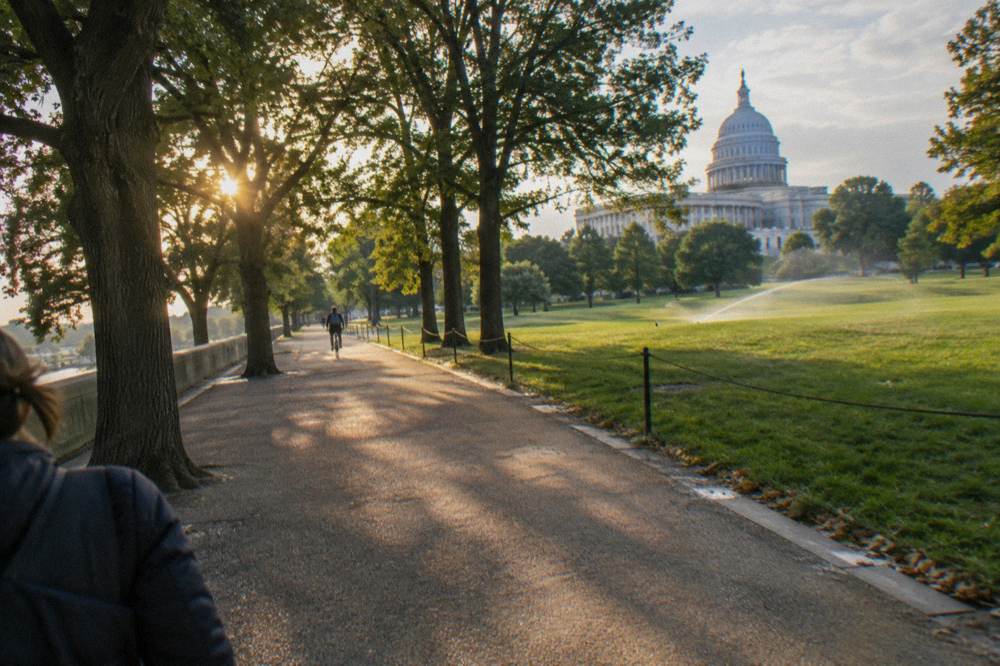
Whether you unlock a shared bike or sit on a tour bike, two wheels cover the monument corridor dramatically better than walking, because the parks stretch across a distance that punishes round trips on foot in summer heat. Bicycles are welcome in National Mall and Memorial Parks, bike parking is provided near each major memorial, and the park never closes. The only real question is which bike, not whether.
Put the alternatives side by side and the trade is easy to see. Walking the full monument corridor means choosing between a rushed single pass and a very long day; the question of whether you can walk the National Mall in one day gets its own treatment, and the short answer involves serious mileage and sore feet. Metro covers the endpoints but skips everything in between, and getting around DC by Metro, walking and bikes shows where transit genuinely helps and where it does not. Bikes fill exactly the gap transit leaves.
The guided versions add something no shared bike can: a route that was designed rather than improvised. The easy-paced Capitol Hill tours, for instance, keep you in the compact, stately quarter around the Capitol, Library of Congress and Supreme Court, which is honestly harder to improvised well on a shared bike because the good riding streets are not always the obvious ones. That is the gap where the paid ride earns its price, and it is the single best answer to this article's underlying question.
Weather, once more, is the multiplier. April normals average a 68-degree high with about 6.4 rain days, May averages 76.5 with the wettest profile of the spring, and by June the average high is 85.1. A guided ride with a fixed start time means the operator is watching the sky and the booking terms, whereas a bike-share day means you are making the call alone with a weather app. Neither guarantees anything, but one of them comes with a human whose job is the call.
Common Questions About Capital Bikeshare Without The App
Can You Use Capital Bikeshare Without The App?
Pricing is public, but Capital Bikeshare does not publish a specific no-app unlock method. Check current unlock options directly with Capital Bikeshare before counting on any workaround, or skip the question entirely with a guided bike tour, where the operator supplies the bike.
How Much Is A Capital Bikeshare Day Pass?
The day pass is $10 per 24 hours. It includes unlimited classic-bike rides free for the first 45 minutes each, then $0.05 per minute, with e-bike minutes at $0.15. Unlock fees are not charged on the day pass.
What Does A Single Capital Bikeshare Ride Cost?
A single ride costs a $1 unlock plus $0.15 per minute on a classic bike or $0.35 per minute on an e-bike. Those are the operator's published tiers.
Do Capital Bikeshare Bikes Come With Helmets?
No. Shared bikes do not include helmets, and DC law requires a helmet for anyone under 16 riding on a public roadway, path or right-of-way. Guided tour listings state that helmets are included, which is a real difference for families.
Can You Ride A Bike Through The Memorials In DC?
Riding inside the memorials is not permitted. At the World War II and Franklin Delano Roosevelt Memorials you walk the bike through, and at other memorials you lock up before entering. Bicycle parking is provided near each major memorial.
Is A Guided Bike Tour Better Than Bike-Share For Visitors?
It depends on what you value. Bike-share is cheaper per short hop and fully flexible. A guided tour brings the bike, a helmet, a route and a narrated story for a fixed price, and it needs no app, no unlock and no clock-watching, which suits travelers who want logistics handled.