E-Bike Or Regular Bike For Seeing DC
The Mall is flat, the distances are longer than they look on a map, and summer in Washington is genuinely hot. Here is how to decide between an e-bike and a regular bike, with the rules, the weather and the tour formats side by side.
Short answer
Most visitors are happy on a regular bike for a 2 to 3 hour loop of the National Mall, because the terrain is flat and guided rides set an easy pace. An e-bike earns its price when heat, fitness differences in a group, or longer routes to the Tidal Basin and Potomac side come into play. Tour prices are on each booking page.
The honest answer to the e-bike question in Washington is that both choices work, and the deciding factors are not the hills. There are essentially none worth mentioning on the National Mall. What actually decides it is heat, how far your day stretches beyond the monuments themselves, and whether anyone in your group would rather coast than pedal. This guide compares the two on distance, weather, rules, price and tour format, using the National Park Service's own cycling rules and DC's legal definition of a motorized bicycle. If your trip lands in spring, the guide to where to see cherry blossoms in DC shows how the Tidal Basin and the Mall trees fit into one ride.
One legal point frames everything: DC defines a motorized bicycle as a two or three wheeler with working pedals and a motor that cannot propel it faster than 20 mph on level ground. That is the limit tour e-bikes meet, and it is why they feel like a gentle tailwind rather than a scooter. It also means the two bike types share paths, rules and parking everywhere in the park, which is why the choice comes down to comfort and route rather than legality.
Is An E-Bike Or A Regular Bike Better For The National Mall?
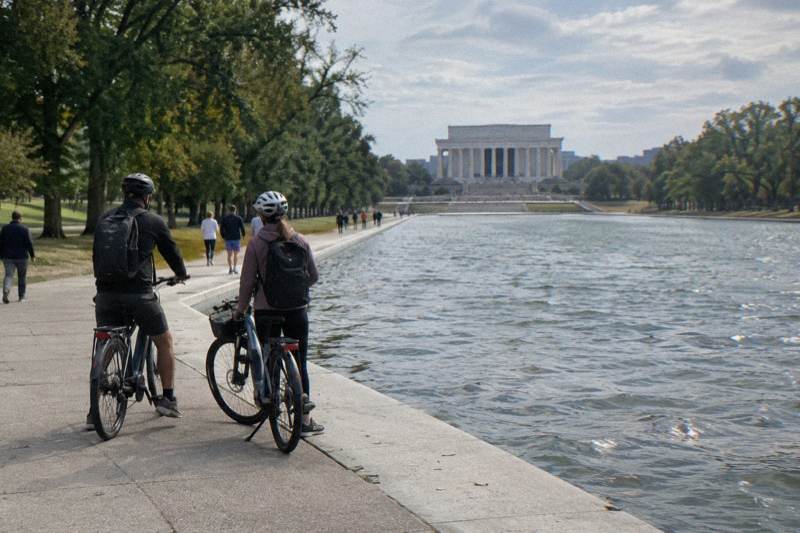
For a pure National Mall loop of 2 to 3 hours, a regular bike is usually enough: the park is flat, guided groups ride at a relaxed pace, and stops at the memorials take more time than the riding between them. An e-bike becomes the better pick when temperatures climb past 85 degrees, when your route reaches the Tidal Basin and the Potomac riverfront, or when two riders in one group have very different fitness levels. Once you've settled on your wheels, the guide to mixing Metro, walking and bikes around DC shows how to pair that ride with transit so the Mall, the Tidal Basin and the memorials all fit into a single outing.
Riding time is a smaller share of a monuments ride than people expect. Between dismounting at memorial plazas, listening to a guide, and walking the bike through the World War II and Franklin Delano Roosevelt memorials where riding is not permitted, a 3 hour tour includes plenty of standing time. On a regular bike that pace suits nearly everyone, including riders who have not touched a bicycle since last summer.
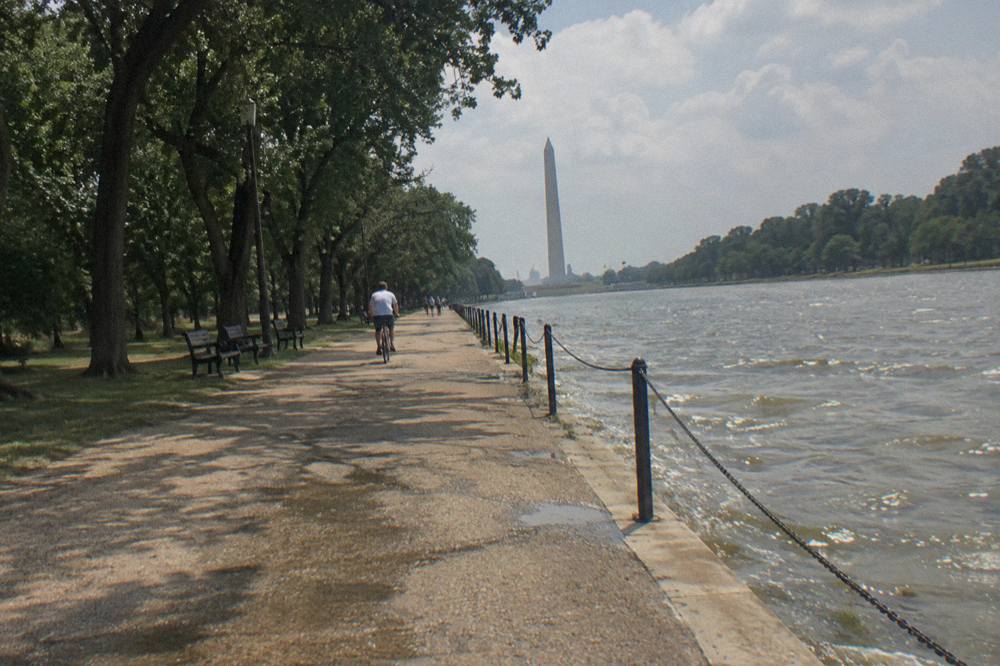
Distance is the counterweight. Riders who want the Mall plus the Tidal Basin, East Potomac Park and a swing past the river in one outing are covering more ground, and August afternoons average a high of 87.8 degrees with July at 89.6. Under that, the motor changes the day from an endurance event into a sightseeing ride. That is the whole reason the 3 hour e-bike formats pair the Mall with the Tidal Basin instead of the Mall alone.
The comparison below compresses the decision into the factors that matter most.

How Much Does The Price Gap Between E-Bike And Regular Bike Tours Matter?
E-bike tours in DC generally cost more than their classic-bike equivalents, and the gap is real but not enormous for a 2 to 3 hour ride; exact figures are on each booking page, since tour pricing here shifts with season and format. What you get for the premium is the motor, the same guided stops, and the ability to add distance without adding fatigue. If the budget is tight, the classic-bike options cover the identical monument list.
Because tour prices change, this site does not print them inline; each booking page shows the live figure, its basis, and what is included. What can be compared structurally is the format itself, and the guided rides listed here split cleanly along bike type lines.
| Tour | Bike type | Duration | Format |
|---|---|---|---|
| Monumental Electric Bike Tour | E-bike | 3 hours | Shared, guided |
| National Mall & Tidal Basin E-Bike Tour | E-bike | 3 hours | Shared, guided |
| Monuments and Memorials Bike Tour (classic) | Regular bike | 3 hours | Shared, guided |
| Monuments Ride, E-Bike Upgrade | Bike or e-bike option | 3 hours | Shared, guided |
| Easy Bike Tour of Capitol Hill Highlights | Regular bike | 2 hours | Shared, guided |
Note the fourth row: one operator sells a single 3 hour monuments ride with a bike or an e-bike option at booking, which is the cleanest way to price the gap yourself, since both versions appear on the same page. If you are torn, book the classic version and check the upgrade price at checkout. That single listing is also the easiest answer for a couple who disagree about the motor, because each rider chooses independently while staying on the same route with the same guide.
For self-guided riders, Capital Bikeshare gives a third price point. A day pass is $10 per 24 hours with classic rides free for the first 45 minutes each, then $0.05 per minute, while e-bikes run $0.15 per minute on the same pass. Single rides without a pass are $1 to unlock plus $0.15 per minute on a classic bike or $0.35 per minute on an e-bike. On a full sightseeing day the e-bike meter can outrun a guided tour's flat price, so the pass is best understood as a classic-bike product. Our Capital Bikeshare or a guided ride guide works through that math in detail.
Do You Need An E-Bike For The Tidal Basin And The Potomac Side?
You do not need one, but the Tidal Basin loop, East Potomac Park and the riverfront add enough distance that an e-bike noticeably shortens the day. The 3 hour e-bike tours that pair the National Mall with the Tidal Basin exist precisely because that combined route is the longest common loop in central DC. Riders on regular bikes do it constantly; they just arrive at the last memorial more tired.
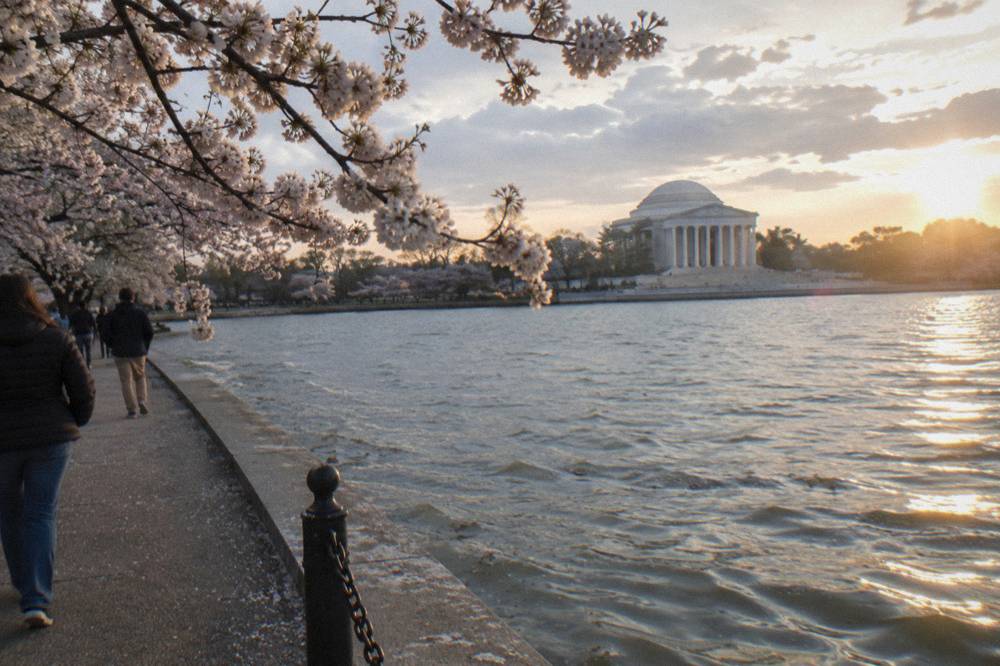
The Tidal Basin is also where DC's cherry blossom crowds concentrate in late March and early April, and riding slow through foot traffic on a heavy classic bike is more work than doing it with pedal assist. The 2026 peak bloom arrived on March 26, and the typical window runs the last week of March to the first week of April, with the 2027 festival set for March 20 to April 11. No peak bloom forecast for 2027 has been published yet, so treat those dates as the festival window, not a bloom promise.
Riders planning to go much farther afield, toward Alexandria and the Mount Vernon Trail, should read the dedicated Mount Vernon Trail by bike guide before choosing a bike; the full day trip to Mount Vernon is a different distance conversation from the Mall, and the 6.5 hour day tour that covers it uses classic bikes with the boat leg as the recovery period.
How Does DC Weather Change The E-Bike Decision?
Washington summers argue for the motor: July and August average highs of 89.6 and 87.8 degrees, and June sits at 85.1, so summer rides are heat decisions as much as fitness ones. Spring and fall are the opposite, with April at a 68 degree average high and October at 69.4, and in that weather a regular bike is comfortable for almost anyone. Winter riders are choosing quiet over warmth.
The table below shows the 30 year climate normals from NOAA for Washington Reagan National Airport, useful for matching bike type to month.
| Month | Avg high F | Avg low F | Rain days | What it means for bike choice |
|---|---|---|---|---|
| March | 56.5 | 38.6 | 6.5 | Blossom season, mild, classic bike fine |
| April | 68.0 | 48.4 | 6.4 | Best regular-bike month |
| June | 85.1 | 67.5 | 6.5 | Heat builds, e-bike worth it |
| July | 89.6 | 72.4 | 6.7 | Peak heat, e-bike or shorter ride |
| August | 87.8 | 71.0 | 5.6 | Still hot, motor recommended |
| October | 69.4 | 52.2 | 4.9 | Excellent classic-bike weather |
These are long term averages, not forecasts; check a live forecast before booking any ride, and see our biking DC in summer heat and rain and cold bike rides guides for tactics. Heat matters doubly on a classic bike because guided tours keep moving; you cannot take a two hour shade break mid-ride, and the memorials offer less shade than their tree-lined approach paths suggest.
Humidity compounds the temperature numbers. A June morning ride before 10 a.m. feels like a different city from the same route at 3 p.m., and riders who only have an afternoon free in summer should weigh the motor accordingly. Morning bookings in July are the budget workaround: same classic bike, same route, far less heat. The rest of the planning pages sit on Bike Tours Washington DC.
What Are DC's Rules For E-Bikes Versus Regular Bikes?
The core rules are identical for both: bicycles of any kind are welcome in National Mall and Memorial Parks, riding is not permitted inside the memorials themselves, and riders under 16 must wear a helmet under DC law. DC regulates e-bikes as motorized bicycles, meaning pedals required and a motor capped at 20 mph on level ground. Bicycle parking sits near each major memorial, and the park is open 24 hours a day.
The National Park Service's cycling guidance for the Mall is the source for the welcome-and-dismount rules: ride the paths, walk the bike through the World War II and Franklin Delano Roosevelt memorials, and lock up before entering the others. The same page confirms parking near the major memorials, per NPS bicycling information. The helmet law for riders under 16 comes straight from the DC Code.
A practical consequence: because the motor stops assisting at 20 mph, an e-bike does not let a tour group skip the dismount-and-walk rhythm of the memorials. The motors change the riding, not the sightseeing. That is worth stating plainly to anyone imagining an e-bike as a shortcut past the crowds; the walks through the memorial plazas are identical on both bike types. Our longer treatment of the rules, including where helmets fit into guided tours, is in helmets and bike rules on the National Mall.
Which Guided Tour Format Fits Each Bike Choice?
E-bike tours in DC run about 3 hours and pair the Mall with the Tidal Basin or the wider river loop, while the classic-bike options split between shorter 2 hour rides on Capitol Hill and full 3 hour monuments circuits. Private tours are overwhelmingly classic-bike products. Matching the bike to the format matters more than matching it to the terrain, since every guided ride is flat.
The 3 hour Monumental Electric Bike Tour is the flagship of the e-bike side, and it is the natural bookend to this whole decision: it exists for riders who have read everything above and decided the motor is worth it. Its booking page carries the current price, meeting point and inclusions. The National Mall and Tidal Basin e-bike tour covers the same idea with a river-focused route. For a closer look at that family of rides, see e-bike tours.
On the classic side, the 2 hour Capitol Hill rides suit riders who want a shorter, cheaper loop, and the monuments ride that offers a bike or e-bike upgrade lets a mixed group split the difference at booking. Families weighing format and pace should also read family bike rides in DC with kids, since kid pace changes the calculus more than any motor.
For shorter loops on a regular bike, the easy-paced Capitol Hill ride is the clearest classic-bike entry point.
Does Battery Range Ever Limit A DC E-Bike Tour?
On guided rides of 2 to 4 hours in DC, battery range is not a realistic constraint: operators run these routes daily and match bikes to the itinerary, and DC's flat terrain draws far less power than hills elsewhere. Range becomes a genuine question only for self-guided riders planning long days out the Mount Vernon Trail or looping the whole riverfront, and even then operators report the guided distances comfortably exceed a single charge. Specific battery figures vary by operator and bike model, so ask when booking rather than assuming a number.
The honest framing is that DC is close to the easiest e-bike city in the country. Flat ground, protected paths and short monument-to-monument hops mean the motor is doing light work. If a listing advertises a specific battery range, treat it as the operator's own claim, and check the booking page for what happens on the rare flat battery, since support policies differ between operators and some send a follow-up vehicle while others swap the bike at the next stop.
Self-guided e-bike renters should add one extra planning step that guided riders never think about: where the bike gets returned. A full day out the river trail that ends far from the rental shop is a logistics question, not a battery question, and it is the most common way self-guided riders misjudge an e-bike day. Guided tours close that gap automatically because the route is a loop back to the start.
What About Night Rides, E-Bike Or Classic?
The night monuments tours in DC are classic-bike rides of about 3 hours, and the format suits them: memorials are lit after dark, traffic is lighter, and cooler evening air removes most of the heat argument for a motor. Sunset in late October falls around 6 p.m., so 3 hour evening rides finish in full dark, and the lit memorials are the whole point of the format.
One closure note for anyone planning a loop this autumn: the reflecting pool area at the Lincoln Memorial is fenced off until late November 2026, which shapes the west end of any route, night or day. The park service notice is the source of truth before you go. Riders booking night tours in the next few weeks should expect the Lincoln Memorial plaza itself to remain reachable while the pool and its walkways are not.
If an evening ride sounds like your speed, the full planning treatment is in night ride past the DC monuments, including what changes after dark beyond the bike itself. For riders who want the lit-memorial experience with the motor, the private-night-ride listings on this site offer that combination; check the booking pages for format details.
How Do You Choose If Your Group Disagrees?
Mixed groups are the single strongest case for e-bikes, because a guided tour moves at one pace and the motor flattens the difference between your fastest and slowest rider. The alternative that also works is the tour sold with a bike or e-bike option, where each rider picks at booking and the group stays together on the same route. Splitting the group across two separate tours is the option nobody enjoys.
Think about who is riding. A group of regular cyclists visiting in April will find a classic monuments ride easy. Add one rider who cycles rarely, or a teenager, or a grandparent, and the same ride at the same pace becomes a different experience for them. The motor is cheapest insurance against the slowest rider dictating, or souring, the day. What to wear and how much fitness a DC ride actually demands are covered separately in what to wear for a DC bike ride and how fit you need to be.
The matrix below matches the most common rider situations to the better pick.
| Rider situation | Better pick | Why |
|---|---|---|
| Spring or fall visit, Mall loop only | Regular bike | Flat terrain, mild normals, easy guided pace |
| July or August afternoon ride | E-bike | 87 to 90 degree average highs make the motor a heat decision |
| Mall plus Tidal Basin and riverfront | E-bike | The longest common loop in central DC |
| Mixed fitness in one group | E-bike, or the dual-option tour | The motor flattens pace differences on a single guided route |
| Short 2 hour loop, tighter budget | Regular bike | The classic Capitol Hill rides cover it at the lower price point |
| Private tour requested | Regular bike | The private guided rides on this site are classic-bike products |
The riders who end up happiest on classic bikes in DC share a profile: visiting in spring or fall, riding 3 hours or less, staying between the Capitol and the Lincoln Memorial, and comfortable on a bike at home. The riders who end up happiest on e-bikes are covering more ground, riding between June and September, or balancing very different abilities in one group. That is the whole decision, and every other factor in Washington, from rules to terrain, treats both bikes the same.
Common Questions About E-Bikes And Regular Bikes In DC
Is An E-Bike Or A Regular Bike Better For The National Mall?
A regular bike handles a 2 to 3 hour Mall loop comfortably, since the terrain is flat and tours move slowly between memorial stops. Choose an e-bike when heat, longer routes to the Tidal Basin and riverfront, or mixed fitness in your group come into play.
Are E-Bikes Allowed On The National Mall In Washington DC?
Yes. Bicycles, including e-bikes, are welcome in National Mall and Memorial Parks. Riding is not permitted inside the memorials themselves; walk the bike through the World War II and Franklin Delano Roosevelt memorials or lock it up before entering others.
How Fast Can An E-Bike Go In DC?
DC defines a motorized bicycle as having pedals and a motor that cannot propel it faster than 20 mph on level ground. Tour e-bikes meet that definition, so the assist feels like a tailwind rather than a moped.
Do Kids Need A Helmet On A Bike In DC?
Yes. DC law requires anyone under 16 riding a bicycle on a public roadway, path or other right of way to wear a securely fastened helmet, and adults may not knowingly let a child ride without one.
Is Capital Bikeshare Cheaper Than An E-Bike Tour?
It can be. A day pass is $10 per 24 hours with classic rides free for the first 45 minutes each, then $0.05 per minute, while e-bikes cost $0.15 per minute on the pass. Guided tours add a guide, a route and included bikes, so they are a different product rather than a straight price comparison.
Do I Need An E-Bike For The Tidal Basin And Cherry Blossoms?
No, but it helps. The Tidal Basin adds distance to a Mall loop, and during the late March to early April bloom window the paths are crowded enough that low-speed balance on a heavier bike is real work. The motor makes that easier without changing the route.