How Much Does A Guided Bike Ride Cost In DC?
A clear breakdown of guided bike ride pricing in DC: per person versus per group, what the price covers, and how it compares with Capital Bikeshare.
A guided bike ride in DC is priced one of two ways: per person on shared group rides, or per group of up to a set number of riders on private rides. The shared rides run from 2 to 6.5 hours depending on the route, and the private rides are sold as a flat price covering everyone in your party up to the stated cap. The exact dollar figure lives on each booking page.
That two-base system trips up a lot of first-time bookers. Someone sees a private ride listed at what looks like a high number and assumes it is the per-person cost of a premium tour, when it is actually the whole-group price for two to five people. Someone else compares a per-person price against a per-group price side by side and concludes the group ride is a bargain, without dividing anything in their head, which is the right instinct: you should never divide a group price yourself, because the cap on group size is what makes the comparison honest.
The guided DC rides listed here split cleanly. Shared rides, which make up most of the market, are priced per person. That includes the 3-hour monuments rides on classic bikes or e-bikes, the 2-hour Capitol Hill rides, the 2-hour cherry blossom rides, the 3-hour night monuments rides, and the long 6.5-hour Mount Vernon day out of Alexandria. Private rides, sold per group, include a 2-hour private tour for up to 4, a private night ride and a customized private route each for up to 2, a family-friendly private ride for up to 2, and a half-day private ride running 4 to 5 hours for up to 5. Check each booking page for the current figure, since these are not printed here.
The practical takeaway is that the right question is not "how much does a bike tour cost" but "what basis is the price on, and how many people is it for." Once you know those two things, the comparison between options becomes straightforward. For a solo traveler or a couple, a per-person shared ride is usually the cheaper door into a guided experience. For a family of four or five, a per-group private ride can be competitive once you count every head, and it comes with route flexibility the shared rides do not offer. If you want to go deeper on that tradeoff, our guide to private and small group rides in Washington DC works through it in detail.
These three rides are a fair cross-section of the price spectrum: the flagship 3-hour shared monuments ride on a classic bike, a shorter 2-hour shared Capitol Hill ride, and a 3-hour e-bike ride for riders who want the motor to do some of the work.
What Changes The Price Of A DC Bike Tour?
Four factors move the price of a DC bike tour: duration, bike type, shared versus private format, and how far the route travels from the Mall. A 2-hour shared ride costs less than a 6.5-hour day trip, an e-bike carries a premium over a classic bike, and private tours charge a flat group price rather than a per-person rate, while routes that leave the city entirely sit at the top of the range.
Duration is the most obvious lever. The shortest guided rides in DC run 2 hours, covering compact territory like Capitol Hill or the Tidal Basin in cherry blossom season. The standard monuments rides run 3 hours. The half-day private ride stretches to 4 or 5 hours, and the Mount Vernon bike-and-boat day out of Alexandria runs 6.5 hours on its longest listing, with a companion option listed at 4 to 7 hours. Time on the bike is the input the operator is pricing, alongside the guide's hours, so the ladder from 2 hours to 6.5 hours is really a pricing ladder in disguise.
Bike type is the second lever. Several DC rides offer an e-bike option alongside the classic bike, and the e-bike version is priced accordingly on the booking page. That matters most in summer heat, on the longer routes, and for riders who want to conserve energy for walking through the memorials. The tradeoffs between the two formats, from the motor rules to the riding feel, are laid out in e-bike or regular bike for seeing DC.
The third lever is privacy. A shared ride sells you a seat on a scheduled departure; a private ride buys the guide for your party alone. The private listings state their group caps directly: up to 2 on two of them, up to 4 on one, up to 5 on the half-day. That cap is the number that makes the price meaningful, so read it before comparing anything. The fourth lever is geography. A ride that loops the National Mall uses one logistics footprint; a ride that starts in Bethesda, runs 4 hours on e-bikes, or rides the Mount Vernon Trail from Alexandria with a boat leg involved is a different operation with different costs, and the booking pages reflect it.
Per Person Or Per Group: Reading The Price Tag
Shared rides in DC quote a per-person price, so multiply by your headcount. Private rides quote a single price per group with a stated cap, up to 5 riders on the largest, so do not multiply anything. The booking page states the basis every time, and the single most common pricing mistake is treating a group price as a per-person price or dividing one to make it look cheap.
The table below shows how the DC guided rides divide by price basis and format. The dollar figures live on each booking page and shift with season and demand; what does not shift is the basis itself, the duration, and the bike type.
| Ride | Duration | Bike | Format | Price basis |
|---|---|---|---|---|
| 3-Hour Monuments Bike Ride | 3 hours | Classic | Shared | Per person |
| Monuments Ride, E-Bike Upgrade | 3 hours | E-bike | Shared | Per person |
| Easy Capitol Hill Highlights | 2 hours | Classic | Shared | Per person |
| 2-Hour Capitol Hill Ride | 2 hours | Classic | Shared | Per person |
| Cherry Blossom, E-Bike Option | 2 hours | E-bike | Shared | Per person |
| Budget Cherry Blossom Ride | 2 hours | Classic | Shared | Per person |
| Night Monuments, English Guide | 3 hours | Classic | Shared | Per person |
| E-Bike, Tidal Basin Route | 3 hours | E-bike | Shared | Per person |
| Private 2-Hour Bike Tour | 2 hours | Classic | Private | Per group (up to 4) |
| Private Night Ride, Pickup | 2.5 to 3 hours | Classic | Private | Per group (up to 2) |
| Private Customized Route | 3 hours | Classic | Private | Per group (up to 2) |
| Private Family-Friendly Ride | 3 hours | Classic | Private | Per group (up to 2) |
| Half-Day Private, 4 to 5 Hours | 4 to 5 hours | Classic | Private | Per group (up to 5) |
| Mount Vernon, 6.5-Hour Day | 6.5 hours | Classic | Shared | Per person |
Notice the pattern in the private rows: the caps are small. These are not fifteen-person coach substitutes; they are built for couples, small families, or a friend group. That is why dividing a group price to get a per-person figure is misleading unless your party exactly matches the cap. A per-group price for up to 2 is a price for two people whether you bring one or two. Where your party is larger, the shared per-person rides and the 6.5-hour Mount Vernon day are the natural fits.
Guided Tour Or Capital Bikeshare: Which Costs Less?
Capital Bikeshare is the budget alternative: $1 to unlock plus $0.15 per minute on a classic bike, or a $10 day pass with unlimited 45-minute classic rides and $0.15 per minute on e-bikes. A guided ride costs more per person but includes the bike, the guide, the route, and the stories; Bikeshare includes the bike alone, and you are your own guide.
The verified Capital Bikeshare pricing makes the arithmetic plain. A single ride on a classic bike is a $1 unlock plus $0.15 per minute, so an hour of pedaling runs about $10 before you dock. The $10 day pass covers 24 hours of unlimited classic rides with the first 45 minutes of each ride free, then $0.05 per minute past that; e-bikes are $0.15 per minute with free unlocks on the pass. There are heavier-use memberships too: $25 per month or $120 per year on the same terms. The system is large, roughly 8,000 bikes across more than 800 stations in 8 jurisdictions, and it returned a station right on the Mall at Jefferson Drive and 12th Street SW in late October 2026, which makes self-guided monument hopping genuinely practical. If you're weighing traditional shop rentals against the docks or wondering when a guided ride beats pedaling solo, our guide to renting a bike in DC and what it costs lays out the options.
| Capital Bikeshare option | Price | What it includes |
|---|---|---|
| Single ride, classic | $1 unlock plus $0.15 per minute | One bike, dock to dock |
| Single ride, e-bike | $1 unlock plus $0.35 per minute | Motor-assisted bike |
| Day pass | $10 per 24 hours | Unlimited 45-minute classic rides, then $0.05 per minute; e-bike $0.15 per minute; free unlocks |
| 30-day membership | $25 per month | Same ride terms as the day pass |
| Annual membership | $120 per year | Same ride terms, free unlocks |
So why would anyone pay for a guided ride? Because the two products answer different questions. Bikeshare answers "how do I get around cheaply." A guided ride answers "what am I looking at." The guide's commentary, the pre-planned route, the support if a bike has a problem, and the simple fact that someone else has thought about where to stop and for how long, are what the premium buys. For travelers with a short window in the city, that difference is worth real money; for locals or repeat visitors who already know the Lincoln Memorial from the Jefferson, it may not be. The full comparison, including where each option wins, is in Capital Bikeshare or a guided ride.
The e-bike question sits in the middle of this comparison. An e-bike ride like the Monumental Electric Bike Tour, a 3-hour shared ride, prices the motor into the per-person figure. Against a Bikeshare e-bike at $0.35 per minute, a three-hour guided e-bike ride is not competing on price at all; it is competing on everything else that comes with it.
What The Booking Price Actually Covers
Every guided ride in this market includes the bike for the duration and a guide; beyond that, inclusions vary listing by listing, and the booking page is the authority. Duration is stated exactly on each listing, from 2 hours to 6.5 hours, and that is your riding window, not including check-in time before the ride rolls out.
The baseline is consistent: you show up at the stated meeting point, the operator fits you to a bike, and the guide leads the route. The National Park Service confirms bicycles are welcome in National Mall and Memorial Parks, with bicycle parking near each major memorial, and riding inside the memorials themselves is not permitted; guides build their routes around walking the bike through the World War II and Franklin Delano Roosevelt Memorials or locking up before entering others. That shapes every monuments ride in the city, regardless of price.
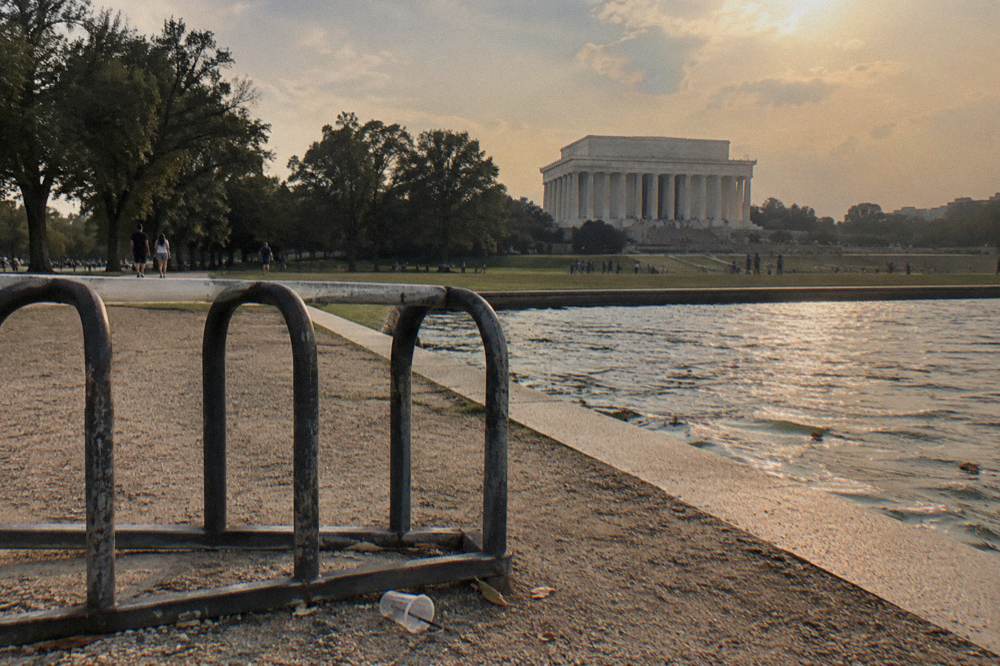
Where listings differ is on the edges: whether a helmet is included or optional, whether the Mount Vernon day includes the boat leg or lists it as an option, whether an e-bike upgrade is a separate price line, and where exactly each ride meets. The meeting points are stated on the booking pages, and the Mount Vernon listings start from Alexandria rather than the Mall, which is part of why that day runs 6.5 hours. If a detail matters to your decision, a helmet for a child, a specific start time, a pickup, check the booking page before assuming, because inclusions are set per listing and this article will not guess at them.
One line of DC law is worth knowing when you read inclusions: any rider under 16 must wear a helmet on a public roadway or path, and parents can be cited for knowingly allowing otherwise. So for families, a helmet is not a nice-to-have for younger kids, it is the law, and the family-friendly listings are built around it.
Seasonal Timing And What You Pay For
DC's guided rides run year-round, but what you get for the price shifts with the seasons: cherry blossom season in late March and early April, summer heat in July and August, and short winter days that push monument rides toward midday departures. Timing your visit well can matter more than the price difference between two rides.
The NOAA 1991 to 2020 climate normals for Reagan National Airport put the pattern plainly. July averages a high of 89.6 degrees Fahrenheit with 4.33 inches of rain; January averages a high of 44.8 and a low of 30.1. April, the blossom month, averages a high of 68 with about 6.4 rain days. These are long-run averages, not forecasts, but they explain the shape of the market: the 2-hour rides sell well in the hot months because a shorter window in that kind of heat is a real product feature, and the 3-hour night rides, which run after sunset, trade heat for darkness. Sunset in late October 2026 was 6:08 p.m., and similar times carry into early November, so the night rides start early enough to catch the memorials lit.
Cherry blossom season is its own pricing event. The 2026 peak bloom arrived on March 26, when 70 percent of the Yoshino trees at the Tidal Basin were open, right in the typical window of the last week of March to the first week of April. Two dedicated 2-hour blossom rides, one classic and one with an e-bike option, exist for exactly this stretch, and the 2027 National Cherry Blossom Festival runs March 20 to April 11, 2027. No 2027 peak bloom forecast had been published as of the end of October 2026, and forecasts generally appear in late February or early March, so the honest position is: book the ride for the festival window if you want the atmosphere, and treat the blossoms themselves as weather-dependent. The details are in cherry blossom peak bloom dates and timing.
A private ride is one way people manage seasonal uncertainty, since a customized private route can lean toward shade, shorter distances, or indoor-heavy stretches in ways a fixed shared route cannot. The private listings run 2 to 5 hours, with group caps up to 5 on the half-day version, and their per-group pricing means the cost does not climb when a cousin joins at the last minute.
Night Rides And Specialty Routes Cost Differently
Night monuments rides are 3-hour shared rides priced per person, and the specialty routes, the Bethesda-start 4-hour e-bike ride and the Alexandria Mount Vernon day at up to 6.5 hours, sit at the top of the duration range. What changes across these is not just price but the whole shape of the day: darkness, distance, and start location.
The night category is straightforward in format: two 3-hour shared rides on classic bikes cover the monuments after dark, and a private night ride for up to 2 with pickup rounds out the category. The memorials are lit in the evening, and the National Park Service keeps the park open 24 hours a day, so the underlying attraction is genuinely there. The operator of one night ride lists seasonal start times, evening departures from April to October and late-afternoon departures from November to March, which is the market's way of tracking sunset through the year. What the night rides demonstrate about price is that operators charge for the guide's evening hours the same way they charge for daytime ones; the premium question is really a product question.
The specialty routes are where duration, and therefore price, climbs. A 4-hour e-bike ride that starts in Bethesda covers ground most Mall-based rides never touch. The Mount Vernon bike-and-boat days, starting from Alexandria, run 4 to 7 hours on one listing and 6.5 hours on the other, with the river leg listed as optional on one. These are full-day commitments priced accordingly, and the ride out the Mount Vernon Trail is a destination in itself; the route is covered in the Mount Vernon Trail by bike, Alexandria to Mount Vernon. For a sense of the corridor that Bethesda ride follows, the guide to biking the Capital Crescent Trail from Georgetown covers what a casual rider can handle and when a guided e-bike version earns its price.
Two closures in force as of late October 2026 are worth a check before any route, paid or free: the Lincoln Memorial Reflecting Pool, its walkways and grass medians are closed until November 20, 2026, and the west side of the Washington Monument grounds is closed through January 23, 2027. Neither closes the Mall, but both reshape photo stops and loops, and guides are routing around them. The National Park Service notices are the source to check before you go.
The Honest Total For A Day Of Riding In DC
Budget roughly for three layers: the ride itself at its listed per-person or per-group price, incidentals like food and water, and nothing for park entry, because the National Mall and its memorials cost nothing to visit. The park is open 24 hours, so an early or late visit costs the same as a midday one. Whatever the ride costs, the ground it covers is free.
That last point deserves more attention than it usually gets. The core sights of DC, the Lincoln Memorial, the Jefferson, the Martin Luther King Jr. Memorial, the war memorials, the Washington Monument grounds, carry no admission. A guided ride is not buying you entry to anything; it is buying interpretation, logistics, and pace. A rider who understands that comparison shops correctly: they ask what the guide adds, not what the gate costs, because there is no gate.
By the same token, the free layers stack. The paths are open around the clock, the park's own bicycling rules welcome bikes with parking near the major memorials, and a $10 Capital Bikeshare day pass turns the whole arrangement into a self-guided loop for the cost of lunch. The guided industry exists because plenty of visitors would rather not plan that loop, and that is a fair thing to pay for on a two-day trip. The full map of where you can ride, on and off the Mall, is in bike lanes and trails in Washington DC: where to ride. And if you want to stretch that free-first approach across the rest of your visit, our guide to free things to do in Washington DC by bike maps out the no-cost routes and stops worth pedaling to.
If the cost question resolves to value for you at this point, the short answer is that the 3-hour shared monuments ride on a classic bike is the format most first-time visitors land on, the 2-hour Capitol Hill ride is the budget- and time-conscious pick, and the 3-hour e-bike ride buys ease of pedaling. Prices live on the booking pages; the shapes of these rides do not.
For more on the planning around the price tag, what to wear for a DC bike ride and our piece on Bike Tours Washington DC cover the rest of the picture. The 3-hour Monuments Bike Ride itself is the flagship example of everything this article describes, a per-person shared classic-bike format, and it is worth a look at the 3-hour monuments ride with an inline option to Check availability.
Common Questions About Guided Bike Ride Costs In DC
How Much Does A Guided Bike Ride Cost In DC?
It depends on the basis. Shared rides are priced per person and run 2 to 6.5 hours; private rides are priced per group with caps of 2 to 5 riders and run 2 to 5 hours. The current dollar figures are on each booking page, and they move with season and demand.
How Much Is The Bike Tour In Washington Dc?
The same answer applies: read the basis first. Multiply a per-person price by your headcount, and never divide a per-group price unless your party matches the cap exactly. Duration, bike type, shared versus private, and distance from the Mall are the four factors that move the number.
Is A Private Bike Tour Worth The Group Price?
For a party that fills the cap, often yes, since the flat price covers everyone and the route can be customized. For one or two riders on a cap-of-5 listing, the math rarely works; a shared per-person ride is the better fit.
Does The Price Include The Bike And Helmet?
The bike for the duration and a guide are standard across the listings. Helmet policy, e-bike upgrades, and extras like the optional river leg on a Mount Vernon day are set per listing, so check the booking page for the specific ride.
Is Capital Bikeshare Cheaper Than A Guided Ride?
Usually yes for the bike alone: a $10 day pass covers 24 hours of 45-minute classic rides. But it buys no guide, route, or commentary. A guided ride prices the interpretation and logistics, not the wheels.
Do I Pay Extra To Enter The Monuments?
No. The National Mall and its memorials are free to visit and the park is open 24 hours. Every dollar of a guided ride goes to the guide, the bike, and the planning, not to admission.