Free Things To Do In Washington DC By Bike
Almost everything worth seeing in Washington DC costs nothing to enter, and a bicycle happens to be the fastest way to move between the free sights. This guide lays out the no-cost memorials, the free riding on the Mall and the Tidal Basin, two verified pay-what-you-want walking tours, and the one place a paid guided ride genuinely adds something.
Short answer
The free core of Washington DC is the National Mall and Memorial Parks: open 24 hours, no entrance fees, with bicycle parking near each major memorial and bikes welcome throughout the park. Add the riverfront paths along the Potomac and the Tidal Basin, plus pay-what-you-want GuruWalk walking tours, and a full free day needs only a bike.
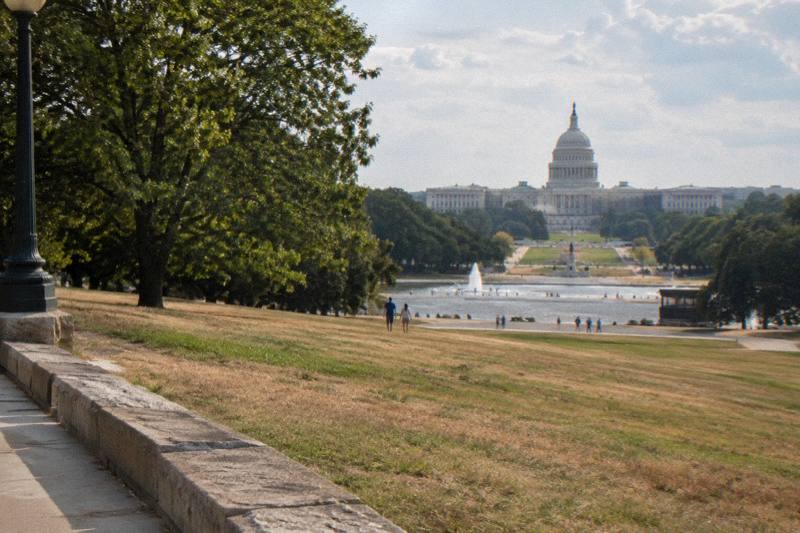
The most useful fact about Washington DC for a budget traveller is also the least advertised: nearly all of the famous sights cost nothing. The Lincoln Memorial, the Jefferson Memorial, the Korean War Veterans Memorial, the Martin Luther King Jr. Memorial, the Tidal Basin, the Capitol grounds, none of them charge admission. What they do charge is time and distance, because the free sights are strung along a long stretch of parkland, and that is exactly where a bicycle earns its keep. The National Mall and Memorial Parks is open 24 hours a day, and bicycles are welcome throughout, with parking near each major memorial.
This guide walks through the free layer of the city in the order you would actually plan it: the memorials that cost nothing, the paths that connect them, two free walking tours you can book at no charge, the season-by-season reality of riding, the rules that apply to bikes, and finally the case for spending money on one guided ride. Free and paid are not rivals here. They solve different halves of the same day.
What Can You See In Washington DC For Free?
Almost the entire monument core of Washington DC is free to enter: the Lincoln, Jefferson, Franklin Delano Roosevelt, Martin Luther King Jr., World War II, Vietnam Veterans and Korean War Veterans Memorials all charge nothing, the park around them is open 24 hours, and the paths linking them are free to ride. The only costs are the bike itself and your own legs.
That list is not a selection of highlights, it is close to the complete set of major memorials. The National Park Service, which runs National Mall and Memorial Parks, does not sell tickets to any of them. The Washington Monument, at 555 feet 5 1/8 inches tall, is the one major structure on the Mall where interior access is managed separately, and its grounds are currently part-closed anyway, which brings us to the practical small print below. The outdoor memorials, the ones you will actually ride between, ask for nothing at the gate because there is no gate.
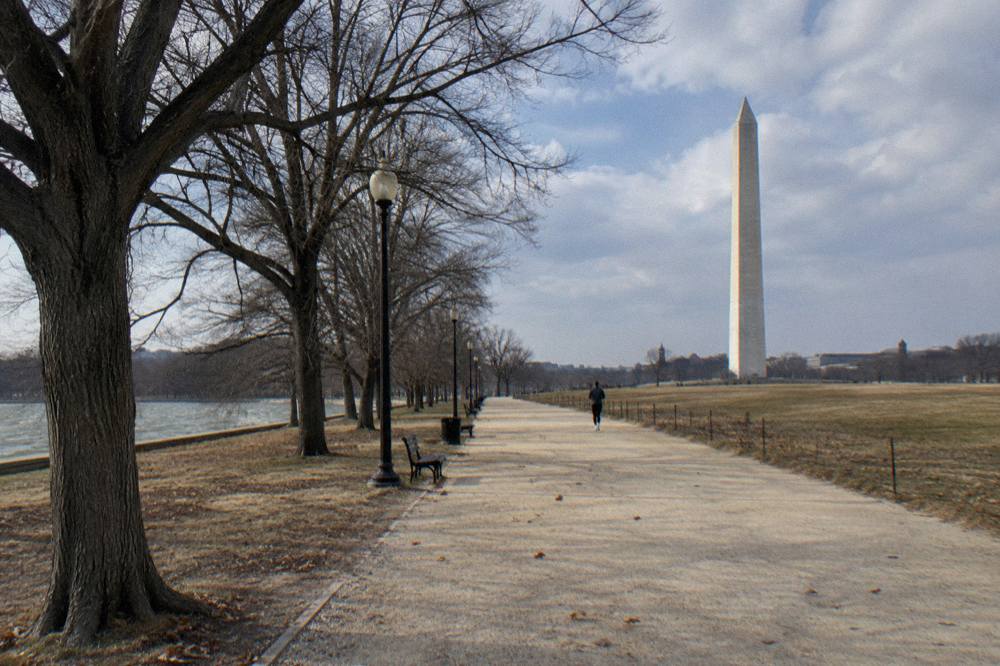
A bicycle turns this from a long walk into a rolling visit. The free sights cluster in three groups: the west end around the Lincoln Memorial and its neighbours, the mid-Mall stretch past the Washington Monument and the World War II Memorial, and the Tidal Basin loop to the south where the Jefferson, Roosevelt and King memorials stand. On foot, connecting all three groups comfortably is a serious day. By bike, the same ground becomes a relaxed morning, with time to stop everywhere you actually want to stop.
One caution applies right now, at the time you may be reading this. The Lincoln Memorial Reflecting Pool, its adjacent walkways and the grass medians are closed until Friday 20 November 2026 at 11:59 p.m. for repairs, and the west side of the Washington Monument Grounds is closed through 23 January 2027 for turf restoration. Neither closure removes the memorials themselves, but both reshape the routes around them. The honest advice is to check the park notice before you plan your loop.
| Free sight | Where it sits | What costs money |
|---|---|---|
| Lincoln Memorial | West end of the Mall | Nothing to enter |
| World War II Memorial | Between Washington Monument and Lincoln | Nothing |
| Vietnam Veterans and Korean War Veterans Memorials | North and south of the Lincoln plaza | Nothing |
| Martin Luther King Jr. Memorial | West side of the Tidal Basin | Nothing |
| Franklin Delano Roosevelt Memorial | Tidal Basin, beside the King Memorial | Nothing |
| Jefferson Memorial | South shore of the Tidal Basin | Nothing |
| Washington Monument grounds | Center of the Mall | Free to walk the grounds; west side closed through 23 January 2027 |
Which Free Memorials Can You Reach Fastest By Bike?
The fastest free circuit by bike links the World War II, Vietnam, Korean War, Lincoln, King, Roosevelt and Jefferson Memorials in one loop, because they all sit within a short ride of each other around the west end of the Mall and the Tidal Basin. Riding between memorials is allowed on the park paths; riding inside the memorials themselves is not.
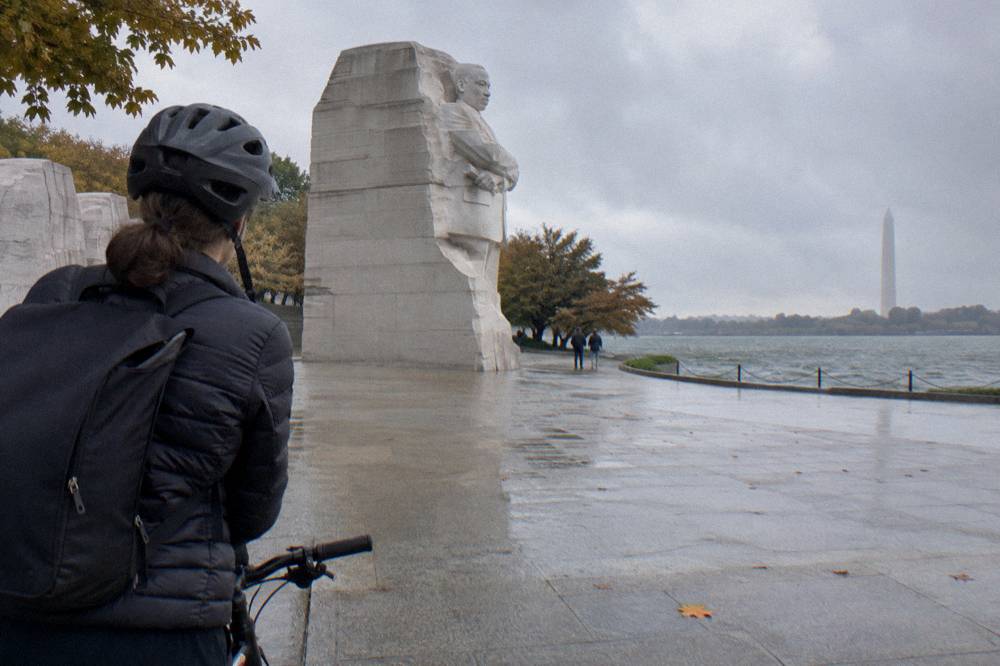
The rule from the National Park Service is simple and worth knowing before your first visit: bicycles are welcome in National Mall and Memorial Parks, bicycle parking is provided near each major memorial and along the Mall, but riding a bicycle is not permitted within the memorials themselves. At the World War II and Franklin Delano Roosevelt Memorials in particular, the expectation is that you walk the bike through; anywhere else, lock it up at the racks before entering. This is not a nuisance rule, it is what keeps the memorial plazas calm places.
Practically, the loop works like this. Arrive on the Mall, ride the length of the monument spine, then swing south at the Lincoln end onto the Tidal Basin path. The Basin carries you past the King and Roosevelt Memorials to the Jefferson, and from there the paths return you along the Potomac side. Nothing on that circuit charges admission, and the whole thing is rideable at a tourist pace with generous stops. For a fuller stop-by-stop breakdown, our National Mall monuments route guide details the sequence and where the bike parking sits.
If you would rather have someone else own the route, the bike and the timing, three guided rides cover this same free ground at a price. That is the trade this article keeps returning to: the sights are free, the guiding is not.
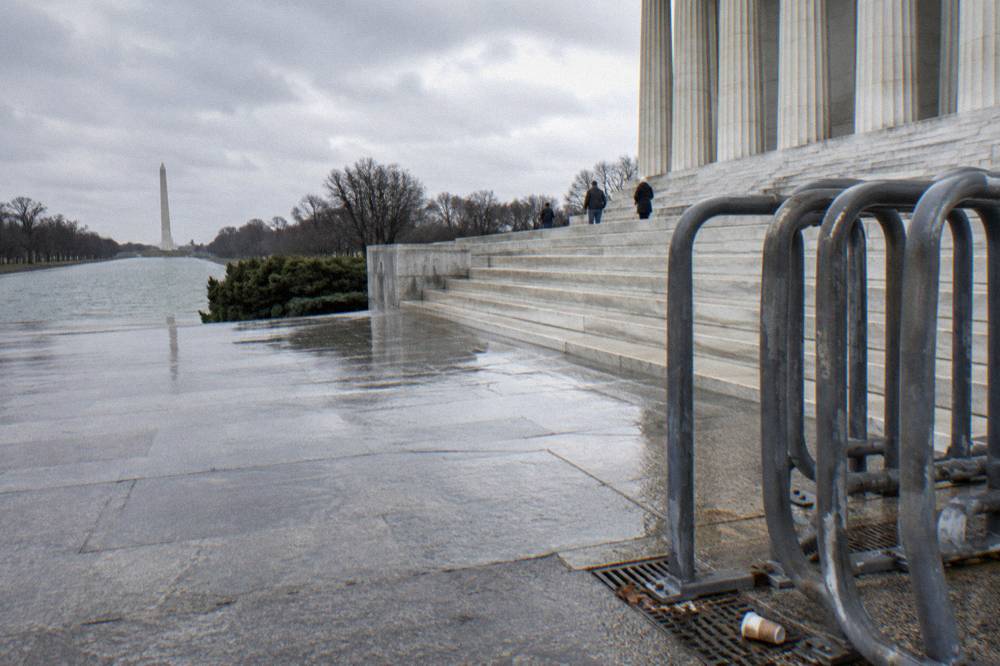
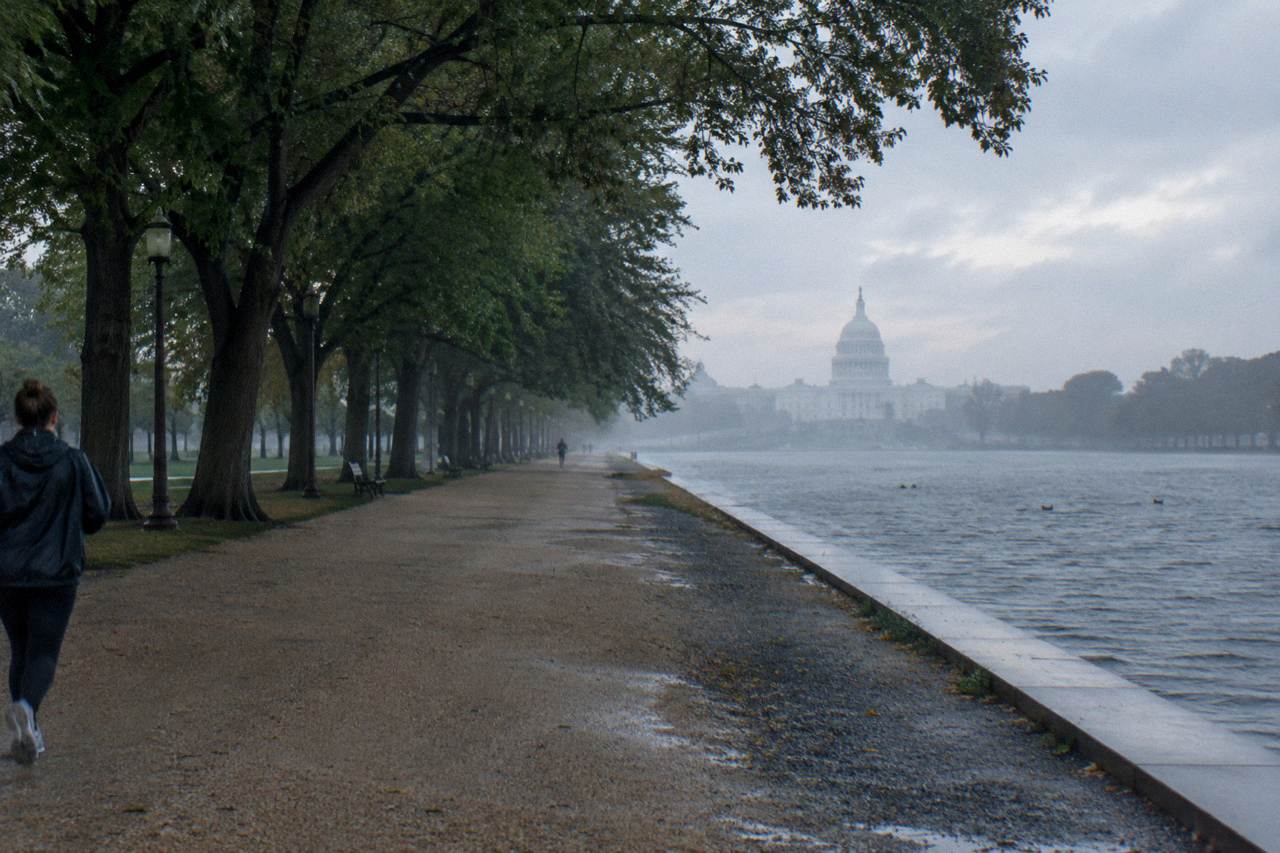
One more free layer deserves a mention. Beyond the memorials, the park itself is the attraction in every season. The Tidal Basin in cherry blossom season, the elms along the Mall in summer, the empty marble terraces on a winter morning, all of it is free and all of it is best from a saddle. If blossom is your reason for coming, read the cherry blossom season by bike guide before you pick a week.

Where Can You Ride For Free Around The Mall And Tidal Basin?
Every path on the National Mall, around the Tidal Basin and along the Potomac riverfront is free to ride, open around the clock, and connected, so a bike loop costs nothing beyond the bike itself. The catch is the bike: Capital Bikeshare is the cheapest turnkey option at $10 for a day pass, but it is not free, so budget travellers should know exactly what that pass buys.
The free part needs no help. The park is open 24 hours a day, the paths are public, and the riverfront continues past the memorials toward Georgetown and across the river toward Arlington, all on car-separated trails. Our bike lanes and trails overview maps the wider network if you want to ride beyond the monument core.
The bike is the one line item, and the honest numbers matter. Capital Bikeshare, the public system with roughly 8,000 bikes at more than 800 stations across eight jurisdictions, prices a day pass at $10 per 24 hours: classic-bike rides are free for the first 45 minutes each, then $0.05 per minute, while e-bikes cost $0.15 per minute. A single ride without the pass is a $1 unlock plus $0.15 per minute on a classic bike or $0.35 per minute on an e-bike. That is cheap, but it is not zero, and the comparison below is worth two minutes of planning.
| Option | Upfront cost | Ongoing cost | Best for |
|---|---|---|---|
| Your own bike or a borrowed one | $0 | $0 | Locals and anyone with a bike |
| Capital Bikeshare day pass | $10 per 24 hours | Classic free first 45 min per ride, then $0.05/min; e-bike $0.15/min | A day of hopping between memorials in under-45-minute legs |
| Capital Bikeshare single ride | $1 unlock | $0.15/min classic, $0.35/min e-bike | One point-to-point hop |
| Guided bike tour | See the booking page | Included in price | Bike, helmet, guide and route all handled |
A useful system-level detail for planning: Capital Bikeshare reinstalled its Smithsonian-National Mall station at Jefferson Dr and 12th St SW in late October 2026, returning a dock to the heart of the monument core. Where exactly you can pick up and drop a bike, and how the app handles it, is covered in our Capital Bikeshare or guided ride comparison.
If even $10 is more than the plan allows, the free fallback is walking, and the two pay-what-you-want tours in the next section cover a meaningful slice of the monument core on foot. That is the real menu: ride free sights on a cheap share bike, or walk them with a free guide.
Are The GuruWalk Free Tours In DC Really Free?
Yes, with one caveat: the two free DC monument walks here run on a pay-what-you-want basis, so there is no fixed price and you tip the guide what the walk was worth at the end. They are walking tours rather than bike rides, they run in English, and together they cover most of the major memorials at the west end of the Mall.
"Free" on the booking platform always means this model: no booking fee, no ticket, you decide the payment afterward. For a budget traveler that is as close to free as guiding gets. DC currently has two all-English free walking tours to pick from.
Walk 1, "Walking Tour of DC Monuments", runs about 2 hours, makes 9 stops, and starts at the World War II Memorial information center at 5 Homefront Dr SW. It covers the Lincoln, Martin Luther King Jr., Franklin Delano Roosevelt and Jefferson Memorials, plus the World War II, Vietnam and Korean War memorials. It carries a 4.41 rating from 335 reviews on GuruWalk, a genuinely substantial pool for a free tour.
See this free tour on GuruWalk
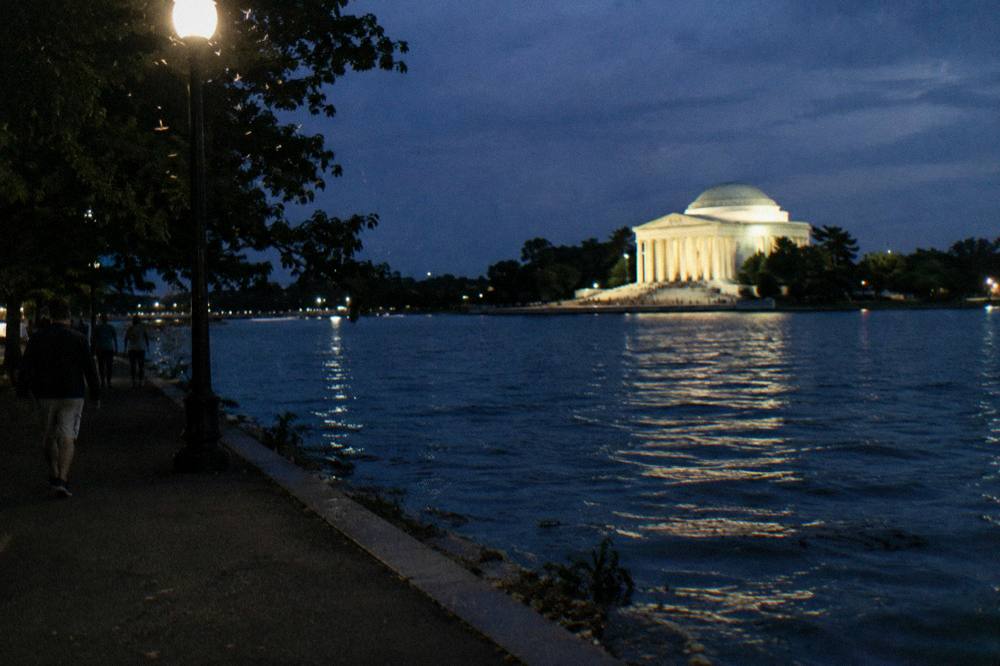
Walk 2, "DC Monuments by Moonlight", is the evening version: about 1 hour 30 minutes, 7 stops, meeting at the Albert Einstein Statue at 2101 Constitution Ave NW. Same pay-what-you-want model, rated 4.26 from 65 reviews on GuruWalk. It is a compact after-dark look at the big memorials, which as our night ride guide explains is when several of them are at their most striking.
See the moonlight walk on GuruWalk
| Walk | Length | Stops | Meeting point | Rating on GuruWalk |
|---|---|---|---|---|
| Walking Tour of DC Monuments | About 2 hours | 9 | World War II Memorial information center, 5 Homefront Dr SW | 4.41 from 335 reviews |
| DC Monuments by Moonlight | About 1 hour 30 minutes | 7 | Albert Einstein Statue, 2101 Constitution Ave NW | 4.26 from 65 reviews |
Neither walk costs anything to join, and both are honest, real options. The limit is the format: they are walks, not rides, so the ground covered is narrower than a bike loop. Remember the closures noted above when planning either one, since the Reflecting Pool work runs through 20 November 2026.
When Is The Best Time Of Year To Ride The Free Sights?
The free sights are open year-round and 24 hours a day, but the comfortable riding windows are April, May, late September and October, when normal daytime highs run from about 68 to 81 degrees. July and August average highs of 89.6 and 87.8 degrees respectively, and winter riding is entirely possible but cold, with normal lows around or just below freezing from December through February.
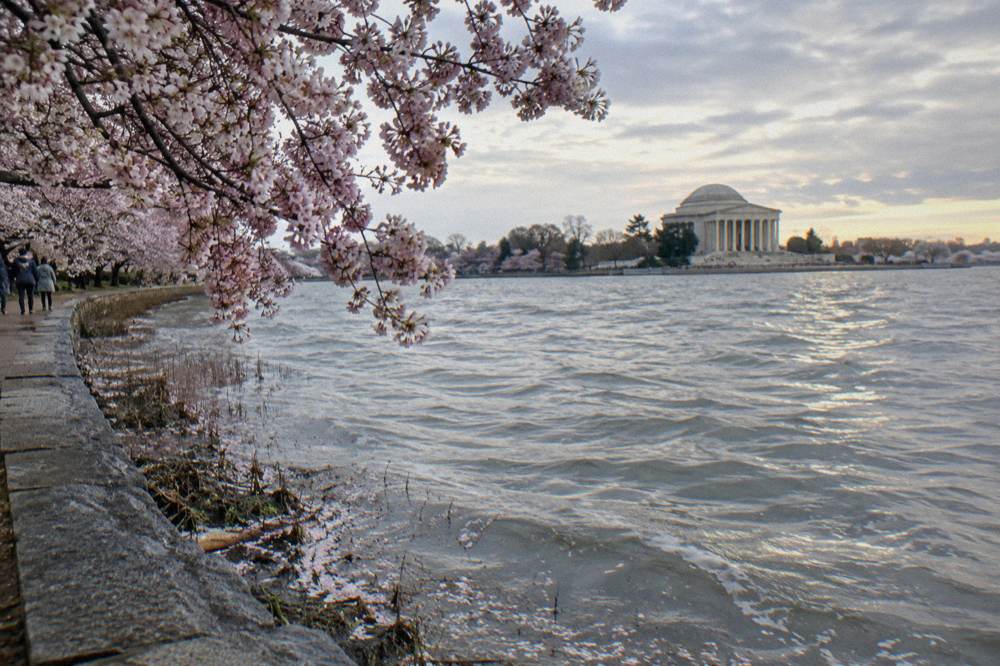
These are climate normals from the 1991 to 2020 NOAA record for Washington Reagan National Airport, not a forecast, and they describe the weather you should plan around rather than the weather you will get. Spring deserves its reputation. April normals of 68 degrees high and 48 low are close to ideal for a monument loop, and late March into early April brings the cherry blossom window: 2026 peak bloom was reached on 26 March, and the typical window runs the last week of March to the first week of April. The 2027 National Cherry Blossom Festival is set for 20 March to 11 April 2027, with no peak-bloom forecast published yet, and the bloom watch page is the source to watch. Blossom timing is never promised, only tracked.
Summer riding is doable with early starts and water; our summer heat guide covers the tactics. Autumn is the sleeper pick: October normals of 69.4 high and 52.2 low, with the fewest rainy days of any month at 4.9. Winter is the quietest and cheapest time to have the memorials nearly alone.
| Month | Normal high | Normal low | Rain days | Riding verdict |
|---|---|---|---|---|
| January | 44.8 | 30.1 | 5.7 | Cold but quiet |
| April | 68.0 | 48.4 | 6.4 | Prime season, plus blossoms |
| July | 89.6 | 72.4 | 6.7 | Ride early or skip to evening |
| October | 69.4 | 52.2 | 4.9 | Comfortable and dry |
What Rules Apply To Bikes On The National Mall?
Bicycles are welcome throughout National Mall and Memorial Parks, with parking near each major memorial, but riding inside the memorials is not permitted, and DC law requires a helmet for anyone under 16 riding on a public roadway or path. Beyond that, the practical rules are few: lock up or walk the bike at memorial plazas, and check the park notices for closures.
The helmet law is the one legal point that matters to families. Under the DC code, it is unlawful for any person under 16 to operate or be a passenger on a bicycle on a public roadway, public bicycle path or other right-of-way without a securely fastened protective helmet, and parents may not knowingly permit it. If your free day includes children, helmets are not optional. Our helmets and rules guide goes deeper.
E-bikes are also welcome on the park paths under the same bicycle rules, and DC defines its "motorized bicycle" category as a two- or three-wheeler with operative pedals and a motor incapable of propelling it faster than 20 mph on level ground. If you are renting or bringing an e-bike, that definition is the standard the city uses.
Two habits make a free riding day frictionless. First, use the racks: parking is provided near each major memorial precisely so you can dismount and enter on foot. Second, check closures before you set out, because the Reflecting Pool and Washington Monument Grounds work described above reshapes the west end of the Mall through late November 2026 and into January 2027.
Where Does A Paid Bike Ride Add Something The Free Options Miss?
A paid guided ride earns its price on coverage and logistics, not access: everything it shows is free to enter on your own, but a guided tour covers more of the Mall and the Tidal Basin side in the same time, and the bike, helmet and guide are included per the booking page. If your time is short, that trade can be worth it. Whichever way you go, the map of DC's bike lanes and riverside trails shows where you can ride freely, where you'll need to walk your bike, and which paths suit first-time visitors.
This is the honest framing, and it is why this article exists on a site called Bike Tours Washington DC. The free plan, self-guided share bikes plus a pay-what-you-want walk, is genuinely good. Its only real gap is ground: the GuruWalk monuments tour covers nine stops in about two hours on foot, which means a tight cluster, while a three-hour guided bike ride such as the Washington DC Monuments and Memorials Bike Tour stretches across the full monument core and the river side in the same afternoon, with the bike and helmet included.
For value on a shorter budget of time, the Washington DC Best of Capitol Hill Bike Tour compresses the Capitol end of the Mall into a two-hour guided loop, a corner the free walking tours do not reach. Check its booking page for price, meeting point and inclusions.
The evening is the other place a paid ride adds something. The free moonlight walk gives you 90 minutes at the west-end memorials; the Washington DC Monuments at Night Bike Tour is a three-hour guided ride across the lit monument core, with the memorials illuminated after dark and the guide narrating stops you would otherwise read off a plaque.
And if the Tidal Basin side, with its cherry trees and the Jefferson Memorial, is the part of the free core you most want covered at ease, the National Mall and Tidal Basin E-Bike Tour does that loop on pedal-assist bikes in three hours. Again, the booking page carries the current price and inclusions.
The decision rule is simple. One relaxed day, low budget, happy to navigate yourself: ride the free sights on a $10 day pass and join a pay-what-you-want walk. One day only, want the whole story and no logistics: one guided ride replaces all of it. Some visitors do both, the guided ride on day one to learn the map, the free loop on day two to revisit the favourites.
Common Questions About Free Things To Do In Washington DC
What Can You Do In Washington DC For Free?
Nearly the whole monument core: the Lincoln, Jefferson, Roosevelt, King, World War II, Vietnam and Korean War Memorials, the National Mall grounds, the Tidal Basin paths and the riverfront trails, all free and open 24 hours. Two pay-what-you-want GuruWalk walking tours add a guide at no fixed price.
Are The Memorials On The National Mall Free To Enter?
Yes. The major outdoor memorials administered by the National Park Service charge no admission. The paths connecting them are free to ride, and bicycle parking sits near each major memorial.
Is Capital Bikeshare Free?
No. A day pass costs $10 per 24 hours, with classic rides free for the first 45 minutes each and $0.05 per minute after, e-bikes $0.15 per minute. A single ride is a $1 unlock plus per-minute charges. It is the cheapest turnkey bike, not a free one.
Are The GuruWalk Tours In DC Actually Free?
They are pay-what-you-want: no fixed price, you tip the guide what the walk was worth. The monuments walk runs about 2 hours with 9 stops, and the moonlight walk runs about 1 hour 30 minutes with 7 stops.
Can You Ride A Bike Inside The Memorials?
No. Riding inside the memorials is not permitted. At the World War II and Franklin Delano Roosevelt Memorials you walk the bike through; elsewhere, lock it at the racks provided before entering.
What Is The Best Time Of Year To Ride The Free Sights?
April, May, late September and October, on 1991 to 2020 climate normals, offer highs between roughly 68 and 81 degrees. Cherry blossom season, typically the last week of March to the first week of April, is the most crowded and most scenic window.